Insurance Agency PPC Strategy
Table of Contents
ToggleHow to Use Google Ads to Drive Traffic to Your Insurance Agency
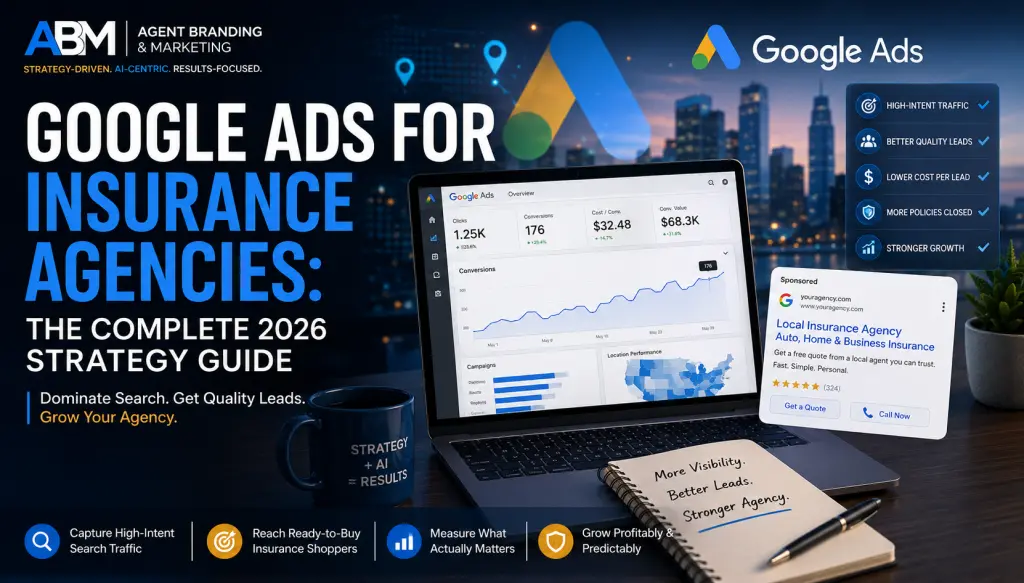
Google Ads can put your agency in front of high-intent insurance shoppers at the exact moment they are looking for help. But the agencies that win are not simply buying clicks. They are building a strategy-driven marketing ecosystem that converts attention into qualified conversations.
Insurance shoppers are not waiting for an agent to find them. They are opening Google, typing in high-intent searches like “auto insurance near me,” “home insurance quote,” or “Medicare agent in my area,” and choosing from the options they trust most.
That is why Google Ads can be a powerful part of an insurance agency’s growth strategy. But paid traffic by itself is not the strategy. It is only one component of a larger marketing ecosystem that must include your website, landing pages, reviews, local visibility, follow-up, content, and measurement.
For insurance agents, the goal is not simply to buy clicks. The goal is to place your agency in front of the right people at the right moment, guide them into a trustworthy digital experience, and turn that attention into qualified opportunities for growth.
Key Takeaways
- Google Ads should be managed as part of a larger insurance marketing ecosystem, not as an isolated traffic tactic.
- Successful campaigns start with audience clarity, defined goals, realistic budgets, and conversion-ready landing pages.
- Insurance agents need to measure more than clicks. Cost per lead, lead quality, quote activity, close rate, and cost per new client matter more.
- Ongoing optimization is essential. Keywords, ads, targeting, landing pages, and follow-up systems should be reviewed consistently.
- AI-powered search and advertising tools are changing how prospects discover insurance agencies, which makes strategy, data, and content quality more important than ever.
Why Google Ads Matter for Insurance Agencies
Insurance is a timing-driven business. People usually search when something has changed: they bought a car, purchased a home, started a business, became eligible for Medicare, moved to a new city, or realized their current coverage may not be enough.
Google Ads allow your agency to show up during those decision moments. That visibility can be valuable, especially in competitive local markets where organic SEO takes time and the strongest competitors are already investing in paid search.
However, Google Ads should not operate in a vacuum. They work best when they support a broader insurance agency marketing plan that connects paid search, SEO, local search, content, reviews, social proof, and follow-up into one growth system.
That ecosystem mindset matters because a prospect rarely chooses an insurance agent from one click alone. They may see your ad, visit your website, check your reviews, compare your Google Business Profile, scan your social presence, and then decide whether you feel credible enough to contact.
Step 1: Know the Audience You Want to Attract
Before launching a Google Ads campaign, define who the campaign is built to reach. Too many agencies begin with keywords before they understand the buyer. That usually leads to wasted budget, weak messaging, and poor lead quality.
A stronger campaign starts with the client avatar. Who are you trying to attract? A young family bundling home and auto? A small business owner looking for commercial coverage? A retiree comparing Medicare options? A high-value homeowner who wants better protection?
Build Campaigns Around Real Insurance Buyer Intent
The best Google Ads campaigns are not built around generic phrases alone. They are built around intent. Someone searching “cheap car insurance” may behave very differently than someone searching “independent insurance agency near me” or “best home insurance agent for new homeowners.”
Understanding those differences helps shape your keywords, ad copy, landing pages, and follow-up process. The more clearly your campaign speaks to the prospect’s situation, the more likely the click becomes a qualified opportunity.
Step 2: Set Clear Goals Before You Spend
Google Ads require discipline. Before a dollar is spent, the agency owner should know what the campaign is designed to accomplish.
Are you trying to increase quote requests? Drive phone calls? Promote a specific line of business? Build visibility in a new service area? Retarget website visitors who did not convert the first time?
The answer matters because each goal requires different campaign structure, targeting, messaging, and measurement.
Common Google Ads Goals for Insurance Agencies
- Generate inbound calls from high-intent local prospects.
- Drive quote requests for auto, home, life, commercial, Medicare, or niche insurance products.
- Increase visibility in specific cities, counties, or service areas.
- Support seasonal campaigns, such as Medicare enrollment or home-buying activity.
- Retarget people who previously visited the agency website but did not take action.
Without clear goals, the campaign becomes a guessing game. With clear goals, every decision can be measured against a defined business outcome.
Step 3: Set a Budget That Matches the Market
Budget is not just a spending limit. It is a strategic decision. The right budget depends on your local competition, target products, service area, expected cost per click, conversion rate, and sales capacity.
Insurance keywords can be competitive. A small budget spread too thin across too many products or locations often produces incomplete data and inconsistent results. A better approach is to focus the budget where your agency has the strongest opportunity to compete and convert.
Agents should also connect budget planning to broader growth economics. ABM has covered this in more depth in its article on what insurance agents should budget for digital marketing, which is a useful companion when planning paid search investment.
Budget Questions Every Agent Should Answer
- Which product line produces the best long-term client value?
- What is the maximum acceptable cost per qualified lead?
- How many leads can the agency team realistically follow up with each week?
- Which geographic areas are most profitable or strategically important?
- How long can the campaign run before performance data is strong enough to evaluate?
A campaign that is underfunded, unfocused, or disconnected from agency capacity will struggle. A focused budget tied to clear objectives gives the campaign room to learn, optimize, and produce.
Step 4: Prepare the Campaign Before Launch
Launching Google Ads is not just a matter of turning on a campaign. Preparation determines whether your paid traffic has a chance to convert.
Before launch, your agency should have the right keywords, compelling ad copy, relevant landing pages, conversion tracking, call tracking, audience exclusions, geographic targeting, and follow-up process in place.
Your Website and Landing Pages Matter
Paid traffic should never be sent to a weak or generic page. If the landing page is slow, confusing, outdated, or missing a clear call to action, your agency may pay for the click and lose the lead.
A strong Google Ads campaign should connect to a website experience built for conversion. That may include quote forms, phone click tracking, trust signals, reviews, location information, and clear next steps. For agencies that need a stronger conversion foundation, ABM’s web design and development service is a strategic place to start.
This is where many agencies lose money. The ad may generate interest, but the website fails to turn that interest into action.
Step 5: Choose the Right Google Ads Campaign Types
Google Ads includes several campaign options, and each has a different role. Insurance agencies should choose campaign types based on strategy, not trend-chasing.
Search ads can capture high-intent prospects actively looking for insurance help. Display and YouTube ads can support awareness and retargeting. Local-focused campaigns can help reinforce visibility in specific markets.
Search Ads
Search ads are often the starting point for insurance agencies because they target people actively searching for coverage, quotes, or a local agent. These campaigns should be organized by intent, product line, and geography.
Retargeting Ads
Retargeting helps keep your agency visible to people who already visited your website. This can be valuable because many insurance shoppers compare multiple options before making contact.
YouTube and Display Ads
YouTube and display campaigns can help build recognition and trust, especially when paired with helpful educational content. These campaigns are usually stronger as part of a full-funnel strategy rather than a direct-response-only campaign.
Local Visibility Support
Google Ads can also work alongside local SEO for insurance agents, Google Business Profile optimization, reviews, and local content. Paid visibility may create the click, but local proof often helps win the decision.
Step 6: Write Ads That Speak to the Prospect’s Problem
Good ad copy is not about being clever. It is about being relevant, specific, and trustworthy.
Insurance prospects are usually looking for clarity, speed, savings, protection, or guidance. Your ad should address the concern behind the search and give the prospect a clear reason to choose your agency over the next option.
Stronger Insurance Ad Copy Focuses On
- The specific insurance need or life event driving the search.
- The local market or service area.
- A clear value proposition, such as guidance, comparison help, convenience, or local expertise.
- A direct call to action, such as calling, requesting a quote, or scheduling a consultation.
- Trust signals that support credibility without overpromising.
Avoid vague language like “we are the best” or “call for all your insurance needs.” Speak directly to the prospect’s situation. Specificity creates confidence.
Step 7: Track the Metrics That Actually Drive Growth
Launching a campaign is only the beginning. Once ads are running, the agency needs to track performance and make decisions based on business outcomes, not vanity metrics.
Clicks matter, but they are not the finish line. A campaign can generate traffic and still fail if the leads are unqualified, the cost per client is too high, or the follow-up process breaks down.
Important Google Ads Metrics for Insurance Agents
- Click-through rate, which shows whether your message is earning attention.
- Conversion rate, which shows whether the landing page and offer are working.
- Cost per lead, which shows how efficiently the campaign is generating inquiries.
- Lead quality, which shows whether the campaign is attracting the right prospects.
- Cost per new client, which connects ad spend to actual agency growth.
- Quote activity and close rate, which reveal whether the leads are turning into revenue.
For a deeper look at performance measurement, review ABM’s article on measuring ROI in insurance marketing. The agents who win are not the ones who simply spend more. They are the ones who know what is working, what is wasting money, and what needs to change.
Step 8: Optimize Campaigns Continuously
Google Ads should never be treated as a set-it-and-forget-it system. Markets shift. Competitors change bids. Search behavior evolves. Landing pages fatigue. Lead quality can rise or fall depending on targeting and messaging.
That is why ongoing optimization is essential. Agents should routinely review search terms, negative keywords, budget allocation, conversion data, ad copy performance, landing page behavior, and geographic results.
Optimization Areas to Review
- Keywords that generate clicks but not qualified leads.
- Search terms that should be excluded through negative keywords.
- Ads with weak click-through or conversion performance.
- Landing pages with high bounce rates or low form submissions.
- Calls that are not being answered or followed up quickly.
- Locations that spend budget without producing results.
Small adjustments can create meaningful improvements. But those changes need to be guided by data and strategy, not guesswork.
Step 9: Connect Google Ads to the Full Marketing Ecosystem
This is where many insurance agencies miss the bigger picture. Google Ads can create visibility, but visibility alone does not create market dominance.
The prospect’s journey may include your ad, website, reviews, Google Business Profile, blog content, social media presence, email follow-up, and phone experience. If those pieces do not work together, the campaign becomes more expensive than it needs to be.
A connected ecosystem gives the prospect repeated proof that your agency is credible, active, local, and capable of helping them make a confident decision.
Why AI Search Makes This Even More Important
Search is becoming more conversational, more personalized, and more AI-driven. Prospects are no longer relying only on simple keyword searches. They are asking longer questions, comparing options, and expecting fast, complete answers.
That shift means your agency needs more than paid visibility. It needs authority signals across the web, structured content, local proof, and a strategy for being understood by both humans and AI-powered search systems. ABM’s article on how AI search is changing how clients find insurance agents explains why this matters for the next era of local visibility.
Google Ads can help you compete today. A connected, AI-aware marketing ecosystem helps you stay visible as search continues to change.
Ready to Turn Google Ads Into a Growth System?
Agent Branding & Marketing partners with insurance agents to build strategy-first, AI-centric marketing ecosystems designed for local visibility, qualified lead generation, and long-term market dominance.
Your agency does not need another disconnected vendor or another campaign that lives in isolation. You need a growth partner that understands insurance, paid search, AI search, local authority, and the systems required to turn attention into production.
Schedule a Strategy SessionPrefer to call? Reach Agent Branding & Marketing at (888) 572-8758.
Conclusion: Google Ads Work Best When Strategy Leads
Google Ads can absolutely help insurance agencies drive traffic, generate leads, and grow visibility. But the strongest results come when the campaign is built as part of a disciplined growth system.
Start with the audience. Set clear goals. Build a realistic budget. Prepare the website and tracking. Choose the right campaign types. Write relevant ads. Measure what matters. Optimize consistently. Then connect the campaign to the rest of your marketing ecosystem.
That is how paid traffic becomes more than a marketing expense. It becomes a strategic growth asset.
To discuss how Google Ads can fit into your agency’s larger growth strategy, schedule a strategy session with Agent Branding & Marketing or call (888) 572-8758.
FAQs About Google Ads for Insurance Agencies
Do Google Ads work for insurance agents?
Yes. Google Ads can work for insurance agents when campaigns are built around clear goals, strong targeting, relevant landing pages, accurate tracking, and consistent optimization. The best results usually come when paid search is connected to SEO, local search, reviews, content, and follow-up systems.
How much should an insurance agency spend on Google Ads?
The right budget depends on your market, competition, product focus, geography, and growth goals. A focused campaign with enough budget to generate meaningful data is usually better than spreading a small budget across too many products or locations.
What types of Google Ads are best for insurance agencies?
Search ads are often the best starting point because they capture people actively looking for insurance help. Retargeting, display, and YouTube ads can also be valuable when used as part of a broader full-funnel strategy.
Should Google Ads send traffic to my homepage?
Not always. In many cases, traffic should go to a focused landing page built around the prospect’s search intent. The page should include a clear call to action, trust signals, contact options, and relevant information that supports the ad message.
What metrics should insurance agents track in Google Ads?
Agents should track clicks, conversions, cost per lead, call volume, lead quality, quote activity, close rate, and cost per new client. The most important question is not whether the campaign generated traffic, but whether it produced profitable agency growth.
Can ABM help manage Google Ads for my insurance agency?
Yes. Agent Branding & Marketing helps insurance agencies build and manage paid media as part of a larger strategy-driven growth ecosystem. Learn more on ABM’s PPC management service page, then schedule a strategy session at https://agentbrandingandmarketing.com/schedule or call (888) 572-8758.
Build a Paid Search System That Supports Market Dominance
ABM helps insurance agencies connect Google Ads, local SEO, website conversion, content, reviews, and AI-aware optimization into one integrated growth ecosystem.
Explore PPC Management Schedule Your Strategy Session