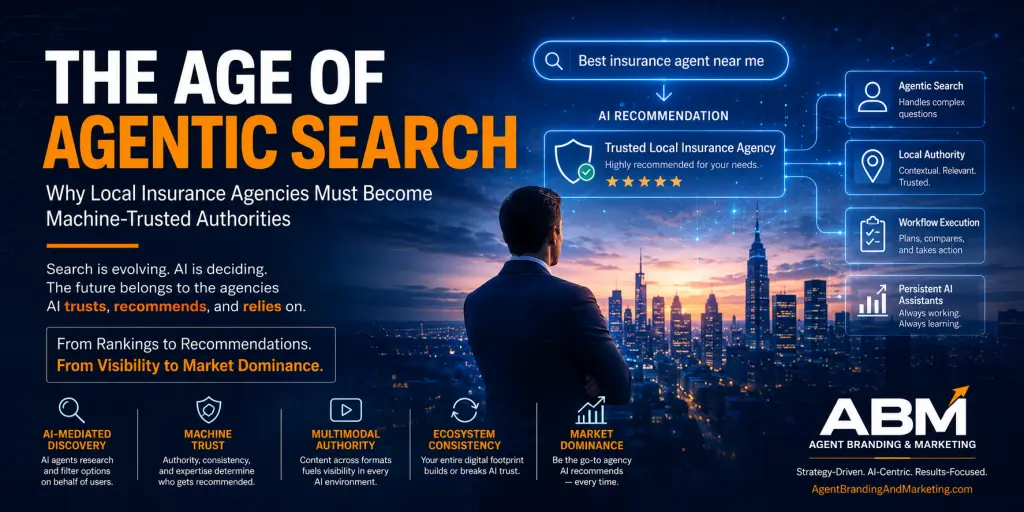
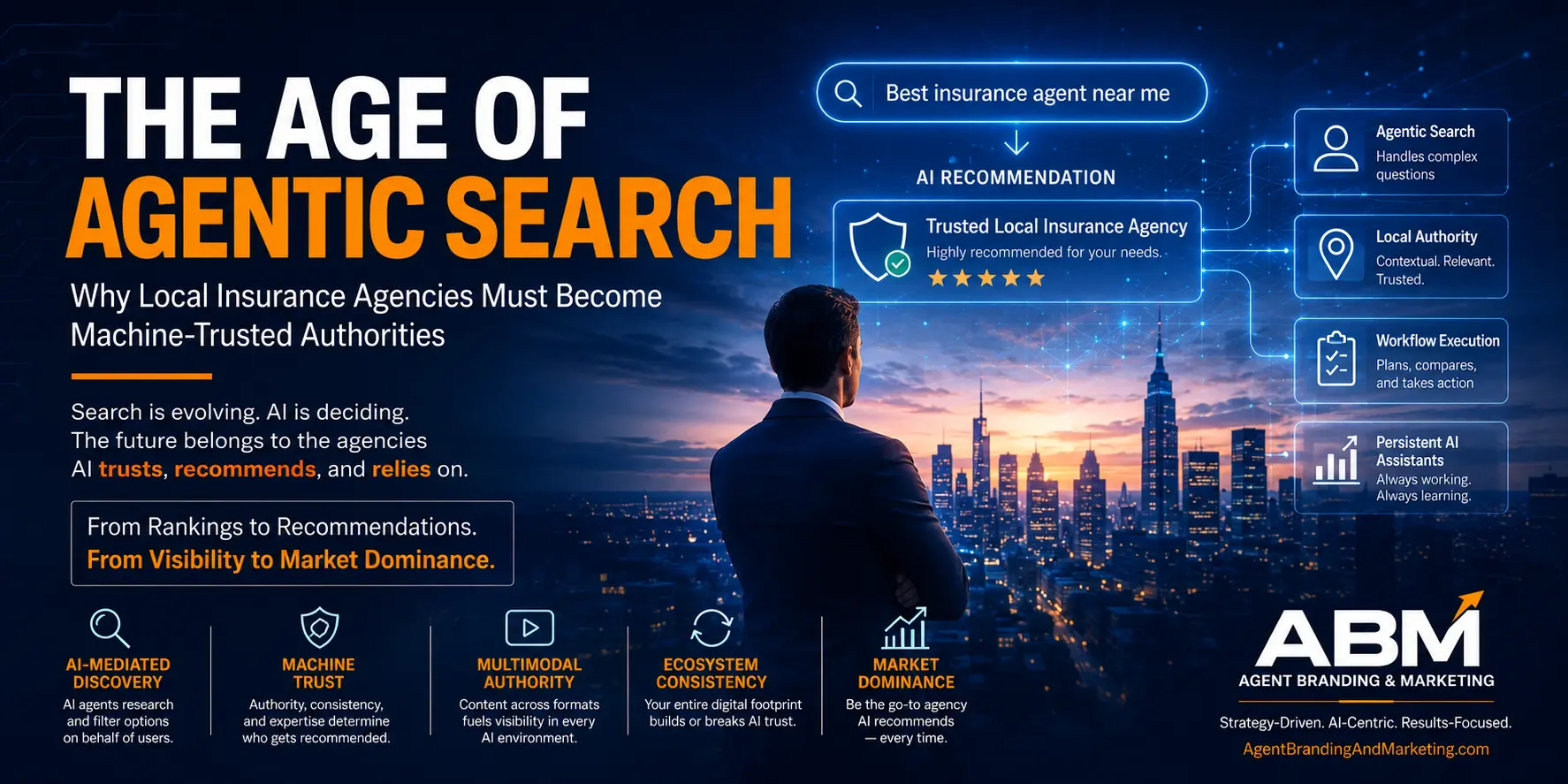
Google I/O 2026 was not another product showcase. It was a signal that the search industry has crossed a line. Google is no longer simply refining how people find information. It is building an AI-mediated decision infrastructure that researches, evaluates, filters, recommends, and increasingly acts on behalf of the user.
For local insurance agencies, that changes the rules of competition.
For years, the digital marketing conversation centered on rankings, clicks, impressions, website visits, and lead forms. Those metrics still matter, but they were built around one assumption: a human being would search, compare options, visit websites, read reviews, and make the final choice manually.
That assumption is becoming weaker by the day.
The next era of search will not be defined by who appears first on a page of links. It will be defined by which agencies AI systems trust enough to surface, summarize, recommend, and include in delegated workflows. The local agent who wins tomorrow may not be the one with the flashiest website or the biggest ad budget. It will be the agency whose entire digital ecosystem is clear, consistent, authoritative, and machine-readable.
The Search Industry Just Changed
Traditional search was a directory. A prospect typed a question, Google returned a set of results, and the consumer worked through the options. Local insurance agencies competed to be visible in that environment through local SEO, Google Business Profile optimization, paid search, content marketing, reviews, and website conversion strategy.
That model is not disappearing overnight. But it is being absorbed into something larger.
AI-powered search is becoming an orchestration layer. Instead of merely presenting options, AI systems increasingly interpret intent, break complex questions into smaller tasks, evaluate available data, compare providers, and produce a recommendation pathway. Search is moving from retrieval to reasoning. From links to answers. From browsing to delegation.
For an insurance agency, that means the strategic question is no longer only, “Can we rank?” The better question is, “Will an AI system trust us enough to recommend us?”
The New Reality
It is no longer enough to get found. The next competitive advantage is becoming the answer AI systems trust.
What Google I/O 2026 Actually Revealed
The most important development from Google I/O 2026 was not a single feature. It was the direction of the entire ecosystem. AI Overviews, multi-step reasoning, AI-organized results, conversational refinement, multimodal search, persistent assistants, and agentic planning all point toward the same future: Google wants search to do more of the work on behalf of the user.
That matters because insurance decisions are rarely simple. A prospect looking for homeowners insurance may also be thinking about roof age, storm exposure, deductibles, flood coverage, claims experience, bundling, premium increases, and whether the person on the other end of the quote request will actually explain the options clearly.
In the old search model, that consumer had to piece the journey together manually. In the new search model, AI can begin organizing the journey for them.
This shifts the center of gravity away from the website as the sole destination and toward the agency’s entire digital footprint as the evidence base an AI system evaluates.
The Old Framework Is Breaking
For years, local insurance visibility could be simplified into a familiar path:
Website → Ranking → Click → Lead
That pathway still exists, but it is no longer the only path. AI-mediated discovery creates a different sequence:
Entity → Trust Signals → AI Recommendation → Action
That second framework is where the future is heading. It is also where many agencies are unprepared.
Why Insurance Agencies Are Uniquely Exposed
Insurance is not a low-trust transaction. Consumers are not simply choosing a product. They are making a decision tied to financial protection, family stability, property risk, compliance, claims support, and long-term confidence.
That makes insurance especially vulnerable to AI-mediated trust evaluation. If an AI system is asked to recommend an agency, it will not rely on one signal. It will look for corroboration. It will evaluate whether the agency appears credible, active, consistent, locally relevant, and authoritative across multiple sources.
The agency with a decent website but weak reviews, inconsistent listings, thin content, inactive social proof, and no clear expertise signals may be technically present online but strategically invisible to AI systems.
That is the new danger.
In the age of agentic search, an agency can exist online and still fail to become eligible for recommendation.
From SEO to Agent Eligibility
Traditional SEO asked whether Google could understand a website.
The next era asks whether AI systems can trust the agency behind the website.
This is the shift from search engine optimization to agent eligibility. Agent eligibility is the condition of being clear, credible, consistent, and authoritative enough for AI systems to consider your agency a reliable recommendation.
It is not about abandoning SEO. It is about expanding the definition of visibility. The agency must be understandable as an entity, not just discoverable as a URL.
That requires an ecosystem.
Your website, Google Business Profile, reviews, citations, videos, social platforms, educational content, local mentions, schema, service pages, and publishing rhythm must all reinforce the same authority story. Fragmentation creates uncertainty. Consistency creates trust.
This is why AI search dominance for insurance agents must be treated as an ecosystem strategy, not a technical add-on.
Machine Trust Is Built Across the Entire Web Graph
Machine trust is not built through one campaign. It is built through repeated evidence.
AI systems increasingly evaluate patterns across the broader web. They compare what your website says with what your Google Business Profile says. They compare reviews with service pages. They compare your social content with your local citations. They compare your publishing history with your claimed expertise. They look for clarity, consistency, recency, and authority.
This is why fragmented marketing becomes dangerous. If SEO is disconnected from content, content is disconnected from social, social is disconnected from reviews, reviews are disconnected from GBP, and GBP is disconnected from your website, the agency creates a scattered authority signal.
That may have been tolerable in the old search economy.
It becomes a liability in the AI search economy.
What AI Systems Need to See
- A clear agency identity across all major platforms.
- Consistent service, location, and expertise signals.
- Recent reviews and visible proof of client trust.
- Structured content that answers real insurance questions.
- Active local presence through GBP, social, and authority content.
- A digital footprint that reinforces the same story everywhere.
Structured Authority Is No Longer Optional
Structured data used to be treated like a technical SEO detail. That thinking is outdated.
In the AI search economy, structured authority is how machines understand who you are, where you operate, what you do, what you are qualified to discuss, and why your agency should be trusted.
Schema, FAQ architecture, service-page clarity, local business data, review reinforcement, and entity consistency are becoming AI trust infrastructure.
The goal is not to manipulate search. The goal is to remove ambiguity. AI systems reward clarity because clarity reduces risk in recommendation.
The insurance agency that becomes easiest for machines to understand becomes easier for machines to recommend.
Conversational Authority Will Separate Winners From Everyone Else
AI search is conversational by nature. Users do not always ask one clean question. They ask messy, layered, evolving questions that reflect how real people think.
An insurance shopper may begin with “best homeowners insurance near me” and quickly move into questions about roof age, wind and hail deductibles, flood exclusions, bundled auto coverage, claims support, replacement cost, and premium increases.
Traditional SEO often treated those as separate keyword targets. AI search treats them as a connected decision journey.
That means agencies need more than content. They need conversational authority architecture. Every major page should anticipate the next question. Every answer should create a path to deeper clarity. Every topic cluster should function like a guided advisory conversation.
This is why content strategy matters more, not less, in the age of AI. Agencies that publish thin, generic content will struggle because AI systems have little reason to view them as trusted authorities. Agencies that build deep, local, practical content ecosystems will become more visible across human and machine search journeys.
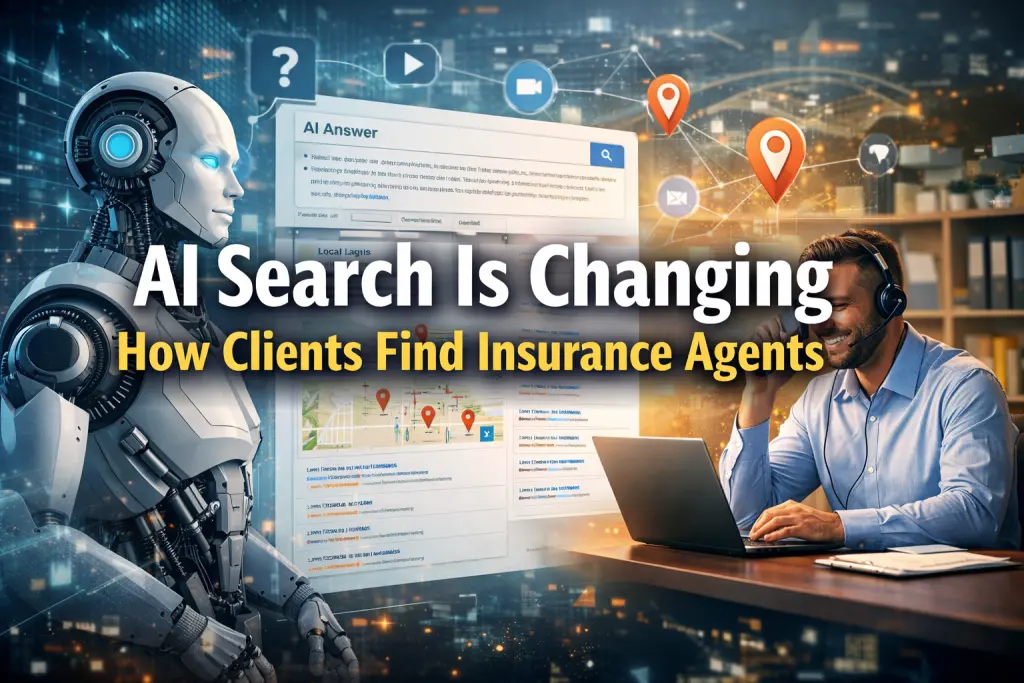
For a deeper look at this shift, ABM’s article on how AI search is changing the way clients find insurance agents provides an important foundation.
Video Is Becoming Search Infrastructure
Video is no longer a nice-to-have trust asset. It is becoming part of the search infrastructure itself.
Google’s continued investment in multimodal understanding, video search, spoken-content interpretation, and AI-assisted video answers means insurance agencies must rethink the role of video in their ecosystem.
A video is no longer just something a prospect watches. It is a source of spoken expertise that AI systems can interpret, summarize, and connect to broader search intent.
This creates a significant opportunity for local insurance agents. A short video explaining flood coverage, a long-form YouTube answer about Medicare options, a claims-process explainer, or a local storm-preparation discussion can all serve both human trust and machine understanding.
ABM has long emphasized that video builds trust faster than text alone. In the AI search economy, it also strengthens discoverability. That is why video marketing for insurance agents should be part of every serious authority strategy.
The New Multimodal Authority Stack
The strongest insurance agencies will not build authority in one format. They will build authority across formats.
A single strategic topic should be reinforced through written content, video, transcripts, FAQ sections, GBP posts, social distribution, internal links, and structured data. The more consistently the agency reinforces its expertise across formats, the clearer the authority signal becomes.
A Future-Ready Topic Should Include
- A comprehensive article or service page.
- A short-form video answering the most common question.
- A longer YouTube explanation for deeper authority.
- A transcript or summary that reinforces machine readability.
- A visible FAQ section aligned with real search behavior.
- Google Business Profile reinforcement.
- Social distribution that keeps the authority signal active.
This is not content volume for the sake of volume. It is authority architecture.
Persistent AI Presence Will Matter
The future of search is not only AI-generated answers. It is persistent AI assistance.
Consumers will increasingly rely on AI systems that remember preferences, compare options, organize decisions, schedule tasks, and make recommendations inside ongoing workflows. That means agencies must stop thinking of visibility as a one-time achievement.
Visibility must become persistent.
An agency that publishes once and disappears creates a weak freshness signal. An agency that maintains active reviews, ongoing GBP updates, regular content, consistent social activity, useful video, and structured service pages creates a living authority footprint.
In the future, dormant agencies will be easier for AI systems to ignore. Active, consistent, authoritative agencies will be easier to recommend.
ABM’s Strategic Response
Agent Branding & Marketing did not need to wait for Google I/O 2026 to understand where search was heading.
ABM has been building toward this reality for years: a strategy-driven, AI-centric growth ecosystem designed specifically for local insurance agencies. We have never believed the future belonged to disconnected tactics. It belongs to integrated systems.
That is why ABM does not operate as a traditional marketing vendor. A vendor sells deliverables. A growth partner builds the system required to win.
The difference matters now more than ever.
ABM’s internal AI-driven strategic environments are designed to evaluate shifts in search behavior, analyze ecosystem visibility, identify authority gaps, accelerate strategic recommendations, and help agencies adapt before the market fully understands what changed.
This is not AI as decoration. It is AI as operational infrastructure.
Within hours of Google I/O 2026, ABM’s internal systems were already analyzing implications for insurance agencies, identifying strategic vulnerabilities, and refining the direction of client ecosystem strategy. That is the difference between reacting to change and operating inside a system built for adaptation.
The Growth Partner Difference
The next era of insurance marketing will not be won by agencies buying disconnected services from disconnected vendors.
It will be won through strategy, systems, AI readiness, ecosystem orchestration, and a partner accountable to long-term market dominance.
Why Traditional Marketing Models Will Struggle
Traditional marketing models were built for channel execution. One team handles SEO. Another handles paid ads. Another writes content. Another posts on social. Another manages reviews. Each function may be competent, but competence in isolation is not enough anymore.
AI systems evaluate coherence.
If the pieces do not reinforce one another, the ecosystem does not build trust at full strength. The agency may spend money across multiple channels while still failing to become a dominant, machine-readable local authority.
That is why ABM’s ecosystem model is so important. SEO, AEO, GEO, GBP, PPC, content, social, web, video, automation, and strategic consulting cannot be treated as separate departments competing for attention. They must function as one integrated authority engine.
That is what the new search economy demands.
What Local Insurance Agencies Must Do Next
The agencies that adapt early will create compounding advantages. The agencies that wait will be forced to catch up in an environment that is already moving faster than traditional marketing cycles can support.
The next phase of local insurance marketing requires a different operating mindset.
- Stop thinking of SEO as a website tactic and start treating it as entity authority architecture.
- Stop treating AI as a content shortcut and start treating it as a strategic intelligence layer.
- Stop separating channels and start building one integrated trust ecosystem.
- Stop measuring visibility only through clicks and start measuring authority, recommendation readiness, and branded demand.
- Stop trying to get found and start building the conditions required to get picked.
Getting there starts with understanding how this new landscape actually works. Our modern marketing education for insurance agents covers the strategy, tools, and skills needed to build the kind of integrated authority ecosystem this article describes.
The agencies that become machine-readable, locally trusted, conversationally authoritative, and persistently visible will have the advantage. Not because they gamed the system, but because they became the clearest answer in the system.
The Next Five Years
Over the next five years, AI recommendation systems will expand. Traditional search result pages will continue changing. AI-generated summaries will become more common. Conversational search will become more natural. Persistent AI assistants will become more capable. Local trust architecture will become more measurable.
Some agencies will continue operating as if the only goal is to rank for keywords and buy more leads.
Others will build the authority systems required for the next era.
Those agencies will not simply compete for attention. They will become the trusted local entities AI systems can understand, verify, and recommend.
The Future Belongs to Machine-Trusted Authorities
The future of insurance marketing belongs to machine-trusted local authorities operating inside integrated AI-centric ecosystems.
That future requires more than a website. More than rankings. More than ads. More than content. More than lead generation tactics disconnected from strategy.
It requires ecosystem orchestration, AI readiness, structured authority, conversational visibility, persistent reinforcement, and continuous adaptation.
ABM is built for that environment. Not as a vendor selling disconnected services, but as a strategy-driven, AI-centric growth partner helping insurance agencies navigate and dominate the next era of search.
Frequently Asked Questions
What is agentic search?
Agentic search refers to AI-powered search systems that do more than return links. These systems can interpret intent, research options, compare information, organize results, and recommend actions on behalf of the user.
How does agentic search affect local insurance agencies?
Local insurance agencies must now compete for AI recommendation eligibility, not just rankings and clicks. Agencies need consistent authority signals across their website, Google Business Profile, reviews, citations, content, video, and social presence.
Is SEO still important in the AI search economy?
Yes. SEO remains important, but it must evolve. Traditional SEO now needs to be connected to AEO, GEO, entity authority, structured data, topical depth, and ecosystem consistency.
What should insurance agencies do first?
Agencies should begin by auditing their entire digital ecosystem for consistency, authority, structured data, review strength, GBP activity, content depth, and local trust signals.
How can ABM help insurance agencies prepare for AI search?
ABM helps insurance agencies build AI-ready growth ecosystems through strategy, SEO, AEO, GEO, local authority development, content architecture, GBP reinforcement, paid visibility, and continuous strategic adaptation.
Ready to Build an AI-Ready Insurance Agency?
The future of search is already moving. The question is whether your agency will be visible, trusted, and recommended when AI systems decide who gets picked.
Related Reading