
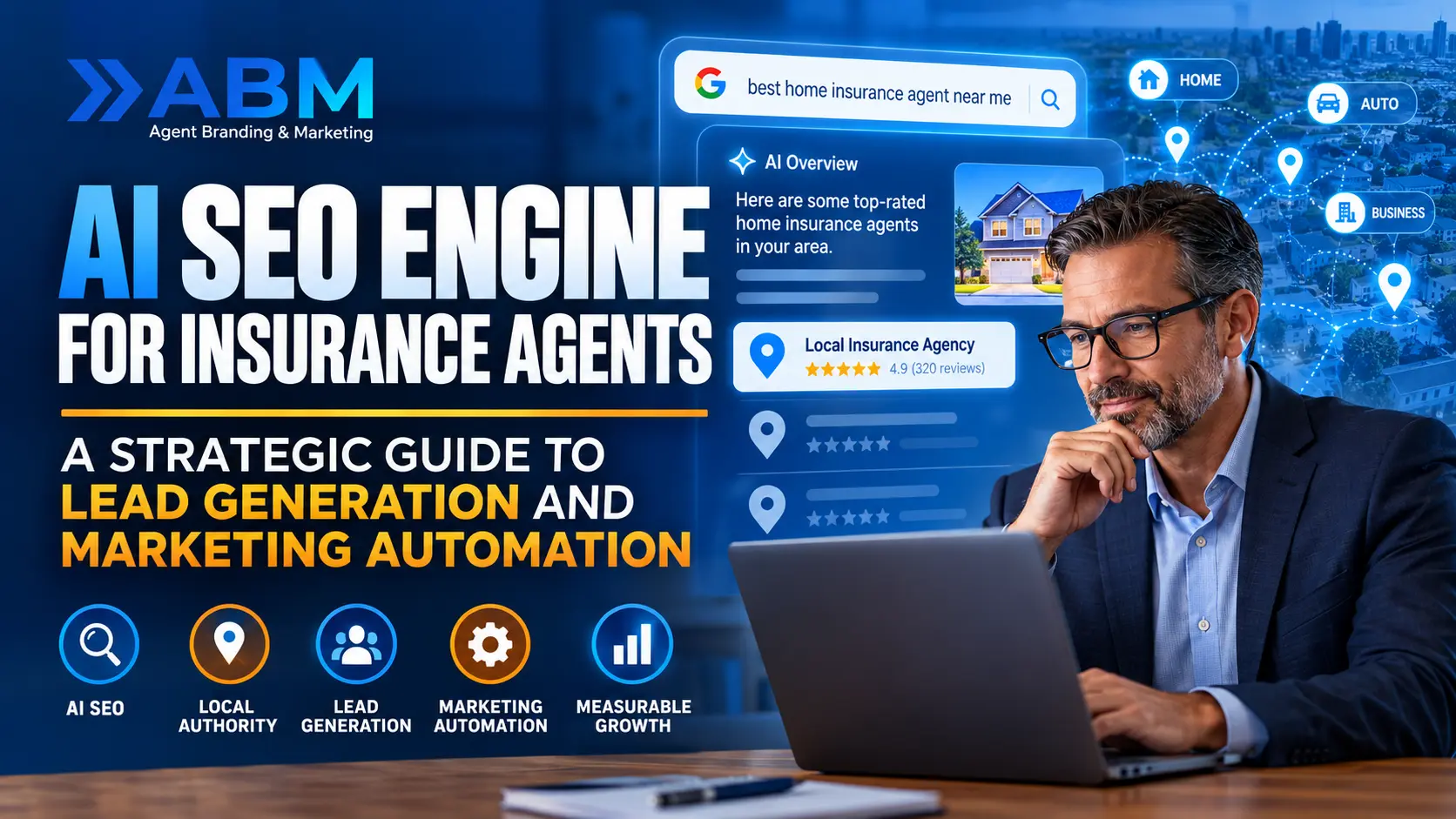
AI SEO Engine for Insurance Agents
A Strategic Guide to Lead Generation and Marketing Automation
By Carl Willis | Agent Branding & Marketing
The way insurance consumers find, evaluate, and choose an agent is changing. Traditional search engine optimization (SEO) remains important, but artificial intelligence is changing how search engines interpret questions, identify relevant businesses, and present information to potential customers.
For insurance agents, this creates both a challenge and an opportunity.
Simply having a website, publishing occasional blog posts, or running advertisements is no longer enough to build a strong competitive position. Your digital presence must work as a coordinated system that attracts qualified prospects, establishes local authority, and turns visibility into measurable agency growth.
This is where an AI SEO engine becomes valuable.
An AI-powered SEO engine uses artificial intelligence to analyze search trends, identify optimization opportunities, improve content relevance, and streamline ongoing marketing activities. When integrated into a broader marketing strategy, it can help insurance agencies improve online visibility, attract higher-quality prospects, and use their marketing resources more effectively.
AI SEO is not a complete growth strategy. It is a powerful component of one.
At Agent Branding & Marketing (ABM), we approach AI SEO as part of an interconnected marketing ecosystem. Search visibility, local authority, paid advertising, educational content, automation, and conversion optimization must support the same business objectives.
The goal is not simply to generate more traffic. The goal is to establish your agency as a trusted local authority and build a predictable system for acquiring and retaining clients.
Key Takeaways
- AI SEO strengthens agency visibility. AI-powered analysis and optimization can help insurance agencies improve their presence in traditional and AI-enhanced search experiences.
- Local authority remains essential. Appearing in relevant local searches, Google Business Profile results, and AI-generated answers can create opportunities to reach consumers actively researching coverage.
- Automation improves execution. AI can streamline keyword research, content optimization, and performance analysis, allowing agencies to operate more efficiently.
- Marketing channels must work together. SEO, paid advertising, social media, website content, and automated follow-up are more effective when connected through a coordinated strategy.
- Educational content builds trust. Answering real insurance questions positions agents as knowledgeable professionals rather than simply another quote option.
- Performance must connect to business outcomes. Rankings and traffic matter, but qualified leads, conversions, and client acquisition provide a clearer picture of effectiveness.
- Continuous optimization creates competitive advantages. AI search continues to evolve, making regular analysis and adjustments essential.
- Long-term growth requires a system. Integrating AI, local authority, and automation into a cohesive strategy creates a stronger competitive position.
Lead Generation Strategies
Lead generation remains a priority for insurance agencies, but generating more inquiries does not automatically translate into better business results. Agents need qualified prospects who are actively considering coverage and recognize the value of working with a knowledgeable local professional.
AI-powered SEO can support this objective by improving how agencies are discovered and how effectively their digital content addresses consumer needs. Three areas deserve particular attention.
1. Optimize for AI-Powered Search Experiences
Search is moving beyond simple keyword matching. Consumers increasingly ask detailed questions about coverage, pricing factors, policy differences, and local insurance options. AI-powered systems can interpret these questions and present information directly within the search experience.
For insurance agents, this means content must do more than contain the right keywords. It needs to provide clear, accurate, relevant answers to the questions potential clients are asking.
AI-assisted SEO tools can help identify these questions, evaluate existing content, and uncover opportunities to improve relevance and clarity. Understanding how AI search is changing insurance discovery helps agencies think beyond traditional rankings without losing sight of search fundamentals.
The strategic objective is to make your agency’s expertise easier to discover and understand, whether a prospect encounters your business through traditional organic results or an AI-enhanced search experience.
2. Strengthen Local SEO and Market Authority
Insurance remains a relationship-driven business, and local visibility is a significant competitive advantage. An agency serving homeowners in Wichita, for example, needs to be relevant to consumers searching for coverage in Wichita and surrounding communities.
Local SEO connects that geographic relevance with consumer search intent. It includes maintaining accurate business information, optimizing location-focused website content, strengthening your Google Business Profile, and developing a consistent online reputation.
These activities reinforce one another. A coordinated local SEO strategy for insurance agencies treats search visibility as part of building the agency’s authority within the market—not a collection of disconnected optimization tasks.
3. Use Educational Content to Attract Qualified Prospects
Insurance buyers often begin researching well before they are ready to request a quote. They want answers to questions about deductibles, coverage options, claims, exclusions, and policy costs.
Educational content allows your agency to participate in those early stages of the decision-making process. Articles, frequently asked questions, and practical explanations can establish credibility while creating additional opportunities for search visibility.
AI can assist with identifying topics, analyzing search intent, and improving content organization. However, the agent’s knowledge and experience remain essential for ensuring information is accurate, useful, and appropriate for the intended audience.
A focused property and casualty insurance content strategy helps connect that educational value with the audiences and markets the agency intends to serve.
The goal is to become the trusted resource consumers find when they need answers—not simply another agency competing for the same search terms.
How AI Automates SEO Tasks to Improve Insurance Agent Visibility
Maintaining effective SEO requires ongoing analysis and adjustments. Keyword opportunities change. Existing content needs refinement. Search behavior evolves. Website performance requires regular evaluation.
For a busy insurance agency, managing these activities manually can consume significant time. AI helps reduce that operational burden by analyzing keyword opportunities, identifying content gaps, recommending improvements to existing pages, and organizing performance data.
This can make routine optimization more efficient and consistent. However, automation should support strategic judgment, not replace it. An agency still needs to determine which markets, insurance products, and customer segments deserve priority.
AI can accelerate the work, but strategy determines where that work should be focused.
Which SEO Automation Techniques Support Lead Generation?
Several automation techniques can support insurance lead generation when implemented within a coordinated marketing system.
- AI-assisted content creation. AI tools can identify relevant topics, organize content, and develop initial drafts based on common consumer questions and emerging search patterns. Human review remains necessary for accuracy, clarity, and compliance.
- Automated PPC management. AI-assisted pay-per-click tools can analyze campaign performance, refine targeting, and support more efficient budget allocation. SEO and Google Ads strategy for insurance agencies should reinforce one another rather than operate independently.
- Automated social media publishing and engagement. Scheduling platforms can help agencies distribute educational content and maintain consistent communication. These activities work best when social media marketing reinforces the same positioning as search, paid advertising, and the website.
The benefit is not simply producing more content or automating more tasks. It is creating a more efficient marketing system that consistently supports visibility, lead generation, and client acquisition.
At Agent Branding & Marketing, we help agencies connect these activities through an insurance-specific growth strategy rather than treating them as isolated marketing projects.
Marketing Automation Techniques
Attracting a qualified prospect is only part of the growth process. Agencies also need reliable methods for engaging interested consumers, following up on inquiries, and maintaining relationships over time.
Without those systems, even successful SEO and advertising campaigns can produce disappointing business results. Marketing automation helps address this challenge by creating more consistent communication and reducing repetitive administrative work.
1. AI-Powered Marketing Tools
AI tools can analyze available client and prospect information to help agencies develop more relevant messaging. Instead of sending the same communication to every contact, agencies can tailor educational content and follow-up messages to different insurance needs and stages of the buying process.
This creates opportunities for more meaningful engagement. The emphasis should remain on communicating useful information—not simply increasing the volume of automated messages.
2. Predictive Analytics
Predictive analytics uses historical information and identifiable patterns to help businesses anticipate potential needs and behaviors.
For insurance agencies, this can support better audience segmentation, more relevant outreach, and more informed marketing decisions. Used appropriately, these insights help agencies allocate attention and resources toward opportunities that align with their growth priorities.
The value comes from improving decision-making rather than relying on predictions as guaranteed outcomes.
3. Automated Email Campaigns
Automated email sequences allow agencies to remain connected with prospects and clients through timely, relevant communication. Educational emails, follow-up messages, and reminders can help maintain engagement throughout the decision-making process.
These systems are particularly valuable when integrated with the agency’s broader marketing activities. A prospect who discovers your agency through organic search should not encounter a disconnected experience once they submit an inquiry.
The messaging, follow-up, and relationship-building process should reinforce the same credibility that attracted the prospect in the first place. Well-designed insurance lead conversion processes connect marketing activity with the work of acquiring clients.
This is the difference between having marketing automation tools and building an effective marketing automation system.
At ABM, our approach emphasizes connecting strategy, AI-assisted marketing, and operational systems so agencies can pursue growth without creating unnecessary complexity.
What Does AI SEO Look Like in Practice for an Insurance Agency?
Understanding AI SEO technology is one thing. Understanding how it contributes to agency growth is another.
Hypothetical illustration: The following example is a planning scenario, not an actual ABM client case study or a claim of achieved results.
Consider an independent insurance agency operating in a competitive suburban market. The agency has an established website, an active Google Business Profile, and a modest advertising budget.
However, its marketing activities operate independently. Website content is rarely updated, advertising campaigns direct visitors to general service pages, and follow-up depends heavily on available staff time.
The agency’s problem is not necessarily a lack of marketing activity. It is the absence of a coordinated system. Here is how an AI-powered marketing ecosystem could change that approach.
Step 1: Identify the Right Growth Opportunity
Instead of trying to improve rankings for every insurance-related keyword, the agency begins by identifying a priority market segment: local homeowners seeking coverage.
AI-assisted research helps the agency identify relevant search questions, geographic opportunities, and gaps in its existing website content. This creates a more focused direction for marketing efforts.
Step 2: Strengthen Local Search Authority
The agency improves its homeowners insurance content to address questions consumers are actively researching.
It also reviews its Google Business Profile, updates relevant business information, and develops additional educational material that reinforces its local expertise. These activities work together to create a more consistent digital presence.
Step 3: Connect SEO With Paid Advertising
The agency aligns its Google Ads campaigns with the same homeowner audience identified in its SEO strategy.
Instead of directing traffic to a generic homepage, advertisements lead prospects to relevant educational and quote-request pages. Organic content and paid advertising now support the same acquisition objective.
Step 4: Automate Lead Engagement
When an interested homeowner submits an inquiry, an automated follow-up process helps ensure the prospect receives timely communication.
The agency’s team remains responsible for personal conversations, coverage recommendations, and relationship building. Automation supports the process without replacing the human expertise that makes insurance relationships valuable.
Step 5: Measure What Matters
The agency monitors search visibility, qualified inquiries, website conversions, and follow-up activity.
Rather than judging success by rankings or traffic alone, it evaluates whether its interconnected marketing activities are creating better opportunities for client acquisition.
The Strategic Lesson
The agency has not simply added an AI SEO tool. It has connected audience targeting, local SEO, content development, paid advertising, and marketing automation into a coordinated growth system.
AI can accelerate individual marketing activities, but integration allows those activities to reinforce one another.
An AI SEO engine becomes considerably more useful when it supports a broader strategy for building local authority, attracting qualified prospects, and developing a stronger competitive position.
How Can Insurance Agents Monitor and Measure AI SEO Performance?
Effective marketing requires meaningful measurement. AI SEO should be evaluated through clear key performance indicators (KPIs) that connect digital activity with agency outcomes.
- Website traffic: Are more relevant consumers discovering the agency?
- Search visibility: Is the agency becoming more visible for important insurance-related searches?
- Engagement: Are visitors interacting with the content and information provided?
- Conversion rates: Are website visitors taking meaningful actions, such as submitting inquiries or requesting consultations?
- Qualified leads: Is increased visibility attracting prospects who fit the agency’s target market?
Tools such as Google Analytics and specialized SEO platforms help agencies monitor performance, identify patterns, and evaluate optimization opportunities.
The most useful reporting goes beyond presenting numbers. It helps agency owners understand what is working, what needs improvement, and where future marketing resources should be directed.
For a deeper look at production-focused reporting, see the insurance marketing metrics that actually drive growth.
What Is an AI SEO Engine and How Does It Benefit Insurance Agents?
An AI SEO engine uses artificial intelligence to analyze website performance, search trends, content relevance, and optimization opportunities.
Traditional SEO often depends on time-consuming manual research, analysis, and implementation. AI can accelerate portions of that work by identifying patterns within larger datasets and producing recommendations that help marketers make more informed decisions.
For insurance agencies, this creates several potential advantages. AI-powered SEO systems can help improve website relevance, strengthen visibility for targeted searches, identify content opportunities, and reduce the time required for routine optimization activities.
These improvements can contribute to more targeted website traffic and stronger lead-generation opportunities. However, an AI SEO engine does not automatically create market leadership.
The technology becomes most valuable when it operates within a clearly defined growth strategy.
For example, an agency focused on attracting local homeowners needs an SEO strategy aligned with that audience, the surrounding geographic market, and the agency’s business objectives. AI can improve the efficiency of executing that strategy. It cannot replace the need to define it.
How to Implement AI SEO Strategies Effectively in Insurance Marketing
Successful AI SEO implementation requires a structured approach. Agents should focus on activities that support their broader growth objectives rather than adopting new technology simply because it is available.
1. Create Educational Content That Builds Trust
Start with the questions your ideal clients regularly ask. Develop accurate, accessible content that explains insurance concepts and helps consumers make more informed decisions.
AI tools can assist with topic research, keyword analysis, content development, and optimization. Agent expertise provides the accuracy and perspective that make the material genuinely useful.
Published content also needs a credible destination. A professional, conversion-focused insurance agency website gives that information a clear structure and a practical path for prospects who are ready to take action.
2. Build Local Authority
Local market visibility involves more than website rankings. Community involvement, local relationships, events, sponsorships, reviews, and a consistent online presence can all contribute to an agency’s reputation.
These activities help reinforce the agency’s identity as an established, accessible insurance resource within its service area. Maintaining an accurate Google Business Profile is one important part of that work.
When local authority efforts align with SEO and other marketing activities, they create a more cohesive competitive position.
3. Use AI Tools to Improve Execution
AI-powered keyword research, content optimization, and performance analysis can make ongoing SEO work more efficient. However, these tools should be selected and used according to the agency’s priorities.
Begin by identifying business objectives, target markets, and the specific opportunities the agency wants to pursue. Technology should then support those priorities.
For every AI-assisted workflow, establish appropriate review of content accuracy, customer information, and applicable insurance marketing requirements. The principles in insurance marketing compliance guidance remain relevant as automation increases.
This approach creates a more measurable and sustainable SEO process.
How Can Insurance Agents Maximize Growth with AI SEO Engines?
AI-powered search and marketing technology will continue to evolve. Insurance agencies need to remain informed about changes in search behavior, optimization practices, and emerging tools that may influence consumer discovery.
Industry webinars, professional events, and ongoing education can provide valuable insight into these developments. But staying informed is only one part of the process.
Agencies must also apply what they learn within a consistent growth strategy. That includes evaluating performance, improving existing marketing activities, and adjusting priorities as consumer behavior changes.
Referral programs also remain valuable. Satisfied clients can become an important source of new business, particularly when an agency maintains strong relationships and delivers a positive customer experience.
AI SEO and referral development should not be viewed as competing approaches. Both can contribute to the same objective: building an agency that consistently attracts new opportunities while maintaining strong relationships with existing clients.
Effective insurance client retention strategies reinforce the value of the relationships an agency has already earned.
Long-term growth comes from the strength of the overall system.
Frequently Asked Questions
These are the questions agency owners most often need answered when evaluating AI SEO as part of their growth strategy.
What are the key benefits of using AI SEO engines for insurance agents?
AI SEO engines can help insurance agencies improve online visibility, identify opportunities for better search rankings, attract relevant website traffic, and streamline optimization activities. They can reduce the manual work associated with keyword analysis, content evaluation, and performance monitoring. When used within a coordinated marketing strategy, these capabilities can support more efficient lead generation, stronger client engagement, and better marketing decisions.
How can insurance agents ensure their content is optimized for AI-powered search?
Start by creating accurate, informative content that directly answers the questions potential clients are asking. Use relevant keywords naturally, organize information clearly, implement appropriate structured data, and ensure the website works effectively on mobile devices. Review and update content regularly to maintain accuracy and relevance. AI tools can support research and analysis, but no optimization technique guarantees inclusion in AI-generated search responses.
What role does local SEO play in the success of insurance agents?
Local SEO helps insurance agencies become more visible to consumers searching for coverage within their geographic market. Important activities include maintaining an accurate Google Business Profile, creating location-relevant website content, managing local business listings, and encouraging authentic client reviews. Together, these activities strengthen local visibility and credibility. For agents focused on building a strong position in a defined market, local SEO is a core part of the broader marketing ecosystem.
How can insurance agents leverage predictive analytics in their marketing efforts?
Predictive analytics uses historical information and behavioral patterns to help identify potential client needs and marketing opportunities. Agencies can use these insights to segment audiences, improve communication relevance, and prioritize follow-up efforts. When applied responsibly, predictive analytics supports more informed decisions and stronger prospect engagement. Its value is in improving decision-making, not guaranteeing a particular sales outcome.
What are some common challenges insurance agents face when implementing AI SEO strategies?
Common challenges include limited familiarity with AI technology, difficulty integrating new tools with existing systems, and the ongoing need to adapt to search changes. Data privacy, information accuracy, and insurance marketing compliance also require attention. These challenges are easier to manage when agencies begin with clear objectives, establish appropriate oversight, and integrate AI into existing business processes. The objective should be a system that supports operations, not added technological complexity.
How can insurance agents measure the effectiveness of their AI SEO strategies?
Agencies should monitor website traffic, search visibility, engagement, conversion rates, and qualified lead generation. Google Analytics and specialized SEO platforms can provide useful performance information. Regular reviews help identify which activities create meaningful opportunities and where adjustments are needed. Ultimately, the value of AI SEO should be measured by its contribution to the agency’s growth objectives.
Conclusion: AI SEO Is Part of a Larger Growth Strategy
AI is changing how consumers discover insurance information, evaluate local agencies, and make purchasing decisions. For insurance agents, search visibility can no longer be treated as a standalone marketing responsibility.
AI-powered SEO offers meaningful advantages. It can improve efficiency, strengthen content relevance, support local visibility, and help agencies identify opportunities that might otherwise be overlooked.
But technology alone is not the answer.
The agencies best positioned for sustained growth are those that connect AI-powered SEO with a broader strategy for building authority, attracting qualified prospects, automating follow-up, and strengthening client relationships.
At Agent Branding & Marketing, we believe insurance agency growth requires more than another marketing vendor or another disconnected tool.
It requires a growth partner that understands the insurance industry, brings strategy to every decision, and uses AI to strengthen an interconnected marketing ecosystem.
Our focus is not simply helping agencies appear in more searches or generate more clicks. It is helping agents build the visibility, credibility, marketing systems, and competitive positioning required for long-term market dominance.
AI makes the system more efficient. Strategy gives it direction. Integration gives it strength.
When those elements work together, insurance agencies can pursue growth with greater clarity, consistency, and confidence.
Build a Stronger Competitive Position for Your Agency
ABM approaches AI SEO as part of a long-term insurance agency growth partnership. Start with your market, your priorities, and the results you want your system to produce.
Call (888) 572-8758 to begin the conversation.