AI-First Search Strategy for Insurance Agencies
The Click Is Disappearing: What Zero-Click and Agentic Search Mean for Local Insurance Agencies
Google is no longer functioning primarily as a directory that sends people to websites. It is becoming an AI-driven decision environment that answers questions, compares options, organizes information, and increasingly acts on behalf of users.
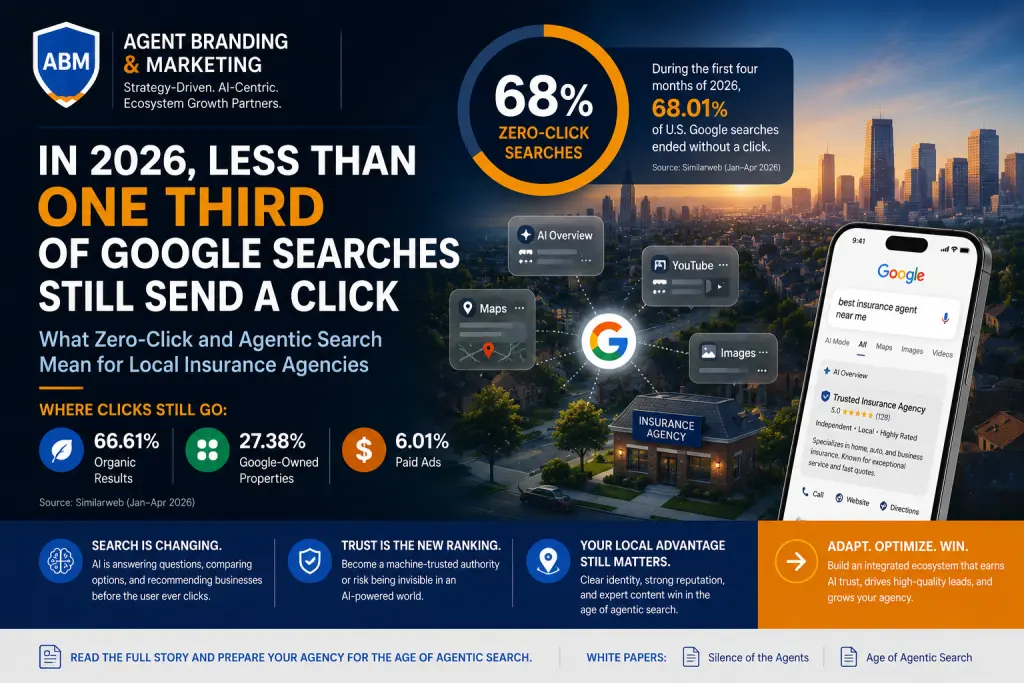
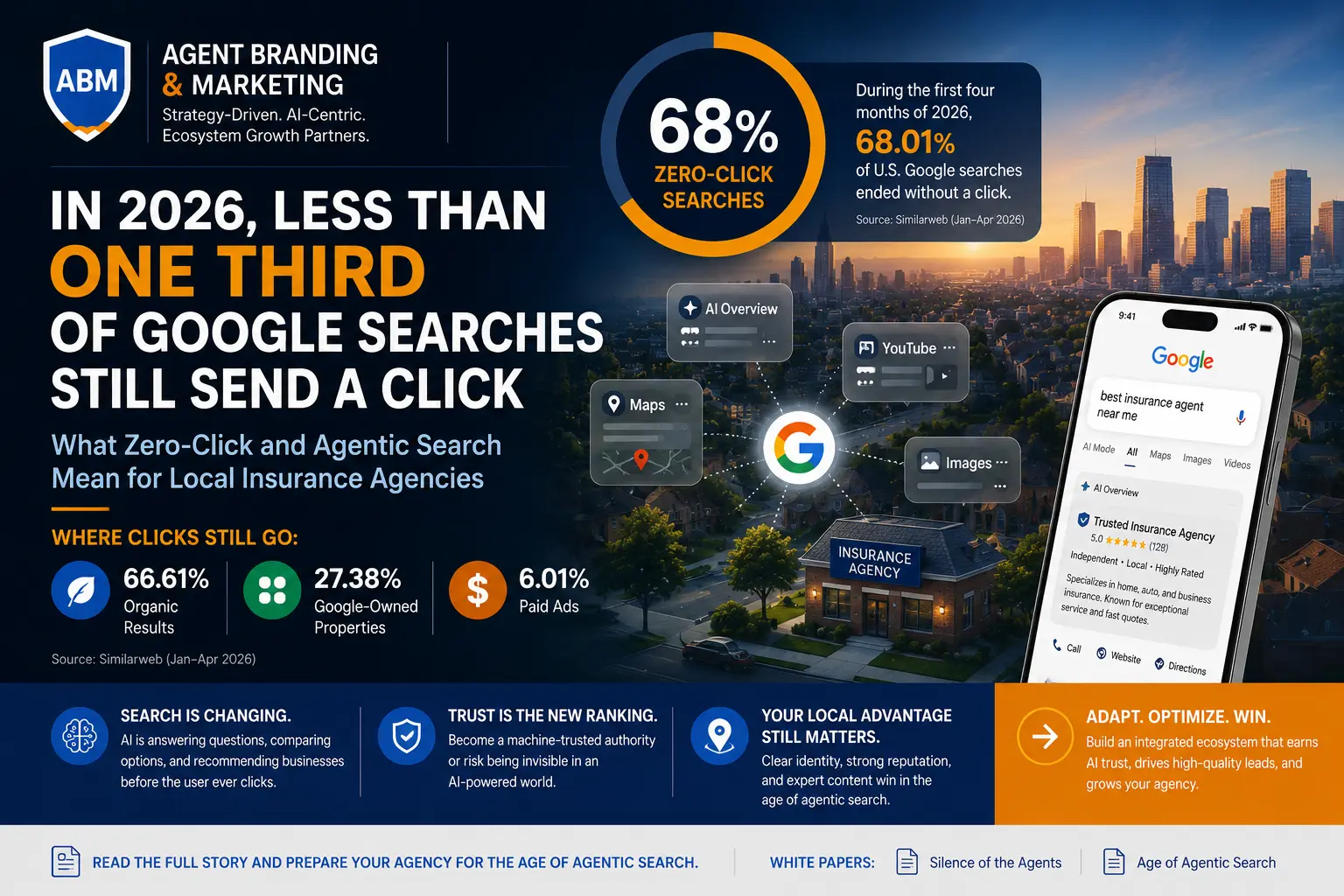
Less Than One-Third of Google Searches Produce a Click
During the first four months of 2026, 68.01% of U.S. Google searches ended without a click. Only about 32% resulted in any click at all. Of those clicks, 66.61% went to organic results, 27.38% went to Google-owned properties such as AI Mode, YouTube, Maps, Images, and News, and 6.01% went to paid ads.
Put another way, for every 1,000 U.S. Google searches, only about 232 clicks reached the open web.
The 2026 analysis was based on U.S. mobile and desktop clickstream data supplied by Similarweb and reported by SparkToro.
Key Takeaways
- Zero-click search is now the dominant search behavior. Visibility can create influence even when it does not create a website visit.
- Traffic is no longer a complete measure of search performance. Agencies must also evaluate branded demand, local visibility, reputation signals, assisted conversions, AI citations, and lead quality.
- AI systems are increasingly narrowing options and comparing providers before the prospect visits a website.
- Traditional SEO still matters, but it cannot operate in isolation from reviews, Google Business Profile management, structured data, video, paid media, social content, and local authority.
- The next competitive objective is agent eligibility: becoming clear, credible, structured, and corroborated enough for AI systems to confidently recommend your agency.
Google Is Becoming a Closed Decision Environment
The shift is not simply a decline in website traffic. It is a structural change in how search works.
In 2024, 60.45% of U.S. Google searches ended without a click. By the first four months of 2026, that figure had climbed to 68.01%—a 7.5-percentage-point increase in two years. In 2019, the reported zero-click rate was approximately 49%.
AI Overviews, AI Mode, instant answers, Maps, video results, and follow-up conversations increasingly allow users to complete research without leaving Google. Even when users do click, a meaningful share of that activity remains inside Google-owned properties.
For insurance agencies, the website is becoming one input within a larger decision system rather than the automatic destination of the customer journey.
Search Is Moving From Retrieval to Orchestration
The old search model
Keyword → Search Results → Website Click → Research → Contact
Most SEO, PPC, website, and attribution systems were built around this pathway. The strategy assumed a human would type a query, compare links, visit websites, and make the decision.
The emerging search model
Need or Goal → AI Interpretation → Multi-Step Research → Provider Comparison → Recommendation or Action
As outlined in ABM’s The Silence of the Agents and The Age of Agentic Search, the future of search is not retrieval. It is orchestration.
AI systems are increasingly designed to research on behalf of users, compare providers, summarize expertise, organize decision pathways, retain context, and facilitate action. The AI system—not the agency website—is becoming the center of the search journey.
What Zero-Click Search Means for Insurance Agencies
Lower traffic does not automatically mean lower influence
Website content can still shape AI-generated answers, featured snippets, Google Business Profile information, local recommendations, branded searches, review validation, and assisted conversions—even when the user never visits the page directly.
That is why abandoning SEO or content would be a strategic mistake. The role of the website is changing, but the website remains a critical authority source for both people and machines.
Traffic alone is becoming a dangerous KPI
An agency can lose organic sessions while gaining more branded searches, direct calls, Google Business Profile engagement, higher-quality leads, stronger local awareness, and better close rates from prospects who encountered the agency elsewhere.
Attribution will become less linear
A prospect may:
- See an answer in an AI Overview.
- Encounter the agency in Maps.
- Watch a YouTube video.
- Read reviews.
- Search the agency name directly.
- Call without ever visiting the original article that influenced the decision.
The New Competitive Standard
Become a Machine-Trusted Local Authority
Traditional SEO asks whether Google can understand your website. Agentic search asks a harder question: Will AI systems trust your agency enough to recommend it when the consumer never performs a traditional search?
ABM defines the strategic response as Agent Eligibility Optimization: the framework for earning AI trust, recommendation inclusion, and eligibility for agent-mediated search and decision workflows.
This does not replace SEO. It expands SEO into a broader trust architecture built across the entire digital ecosystem surrounding the agency.
The Five Conditions of Agent Eligibility
- Machine trust: A structured and corroborated digital presence that an AI system can evaluate with confidence.
- Entity clarity: Consistent agency identity, services, locations, credentials, and contact information across the web.
- Conversational authority: Content that follows the real questions, comparisons, objections, and decision paths of insurance consumers.
- Ecosystem coherence: Every channel reinforces the same expertise, geography, positioning, and trust narrative.
- Persistent visibility: Ongoing publishing, reviews, profile updates, video, and engagement that signal an active, credible business.
The Ecosystem Is Infrastructure
AI systems do not evaluate a website in isolation. They compare signals across the wider web graph surrounding the business.
- Website content and structured data
- Google Business Profile information
- Reviews and reputation signals
- Local citations and directory listings
- Video, social profiles, and community mentions
- Topical authority and branded search behavior
Fragmentation creates conflicting evidence. Ecosystem coherence creates a defensible recommendation. That is why SEO, PPC, social media, Google Business Profile management, reviews, content, video, automation, and website strategy must operate as one growth system—not as disconnected vendor deliverables.
What Insurance Agencies Should Do Now
1. Replace traffic-only reporting with an ecosystem dashboard
Track traffic, but measure it alongside:
- Branded search growth
- Google Business Profile calls, messages, and direction requests
- Local share of visibility
- Review velocity and sentiment
- Lead quality and close rate
- Assisted conversions and direct inquiries
- AI citation and recommendation visibility
2. Strengthen entity clarity across the web
Audit and standardize the agency name, address, phone number, office hours, service areas, insurance lines, team information, licenses, credentials, and location details across every major platform and directory.
3. Build content around natural-language decisions
Move beyond isolated keywords. Build content around complete questions such as:
- What coverage should a first-time homeowner consider?
- How should home and auto coverage be bundled?
- What should a family compare before changing insurance agencies?
- Which local factors affect homeowners insurance costs?
- What documents should a prospect prepare before requesting a quote?
4. Publish every core topic in multiple formats
Turn one strategic topic into a detailed article, a short-form video, a YouTube explanation, a Google Business Profile post, a social post, an FAQ, and structured data where appropriate. Multimodal publishing gives AI systems more surfaces from which to retrieve, verify, and reinforce your authority.
5. Treat reviews as structured trust evidence
Review strategy should emphasize recency, consistency, service-specific detail, geographic relevance, professional responses, authenticity, and compliance—not raw review volume alone.
6. Keep investing in high-intent local search
SEO is not dead. Paid search is not obsolete. High-intent local discovery still matters. The strategy is to keep capturing demand while building the authority signals that influence AI-generated decisions across the broader ecosystem.
What Agencies Should Stop Doing
- Treating rankings as the finish line. A ranking has limited value when the answer is delivered before the click or the agency lacks the corroborating signals needed to be recommended.
- Publishing generic content for volume. Thin city pages, repetitive policy descriptions, and undifferentiated AI-generated content do not create defensible local authority.
- Operating channels in isolation. Paid ads without reputation support, SEO without conversion strategy, and GBP activity without citation consistency all create fragmented trust.
- Measuring every channel by direct clicks. Visibility inside zero-click environments can still create familiarity, branded demand, assisted conversions, and stronger trust before contact.
The Strategic Opportunity for Local Insurance Agencies
Insurance remains a trust-driven category. Prospects value local knowledge, credibility, reputation, and guidance through complex decisions. AI systems still need authoritative local entities to recommend.
In a traditional map pack, three agencies may earn attention. In an agentic search environment, the AI system may narrow the field, rank the evidence, recommend one or two agencies, and facilitate the next step.
The objective is no longer simply to appear somewhere in the results. It is to become the most defensible recommendation.
The Click Is Becoming Optional. Trust Is Not.
The agencies that dominate the next era will not be those chasing every new feature. They will be the agencies that build the clearest, most consistent, and most credible local authority system—giving both people and machines enough evidence to choose them.
Schedule a Strategy SessionFrequently Asked Questions
What is a zero-click search?
A zero-click search is a Google search that ends without the user clicking a result. The user may receive an answer directly, perform another search, interact with a Google feature, or end the session.
What percentage of Google searches end without a click?
According to the 2026 analysis using Similarweb mobile and desktop clickstream data, 68.01% of U.S. Google searches ended without a click during January through April 2026.
Does zero-click search mean SEO is dead?
No. SEO still supports branded visibility, local discovery, high-intent searches, AI answers, Maps results, and machine understanding. Its role is expanding beyond earning website visits.
Why should an agency invest in content if fewer people click?
Content supplies the information that search engines and AI systems use to understand expertise, answer questions, compare providers, and generate recommendations. Influence can occur even when the user does not visit the page directly.
What is agentic search?
Agentic search occurs when an AI system does more than retrieve information. It can interpret a goal, conduct multi-step research, compare options, retain context, organize a decision, and potentially take action on the user’s behalf.
What is Agent Eligibility Optimization?
Agent Eligibility Optimization is ABM’s strategic framework for helping a local agency earn machine trust, recommendation inclusion, and eligibility for AI-mediated workflows. It emphasizes entity clarity, corroborated authority, conversational content, ecosystem coherence, and persistent visibility.
What is machine trust?
Machine trust is the confidence an AI system develops from consistent, structured, credible, and corroborated signals across an agency’s website, Google Business Profile, reviews, citations, content, video, social presence, schema, and broader digital footprint.
Which metrics should replace website traffic?
Traffic should remain part of reporting, but it should be evaluated alongside branded search demand, Google Business Profile activity, local visibility, review growth, lead quality, close rate, assisted conversions, direct inquiries, acquisition cost, and AI citation visibility.
Will paid search still matter?
Yes. High-intent paid search can remain an important demand-capture channel. It must operate inside a broader ecosystem that supports trust, conversion, retargeting, measurement, and AI-era visibility.
What should an insurance agency prioritize first?
Begin by auditing entity consistency, Google Business Profile completeness, review quality, website structure, local citations, high-intent content, and measurement. The first priority is creating a coherent digital identity that every channel and data source reinforces.
Research sources: SparkToro: In 2026, Less than One Third of Google Searches Still Send a Click and Similarweb.
ABM white papers: The Silence of the Agents and The Age of Agentic Search.