Insurance Agency Growth Strategy
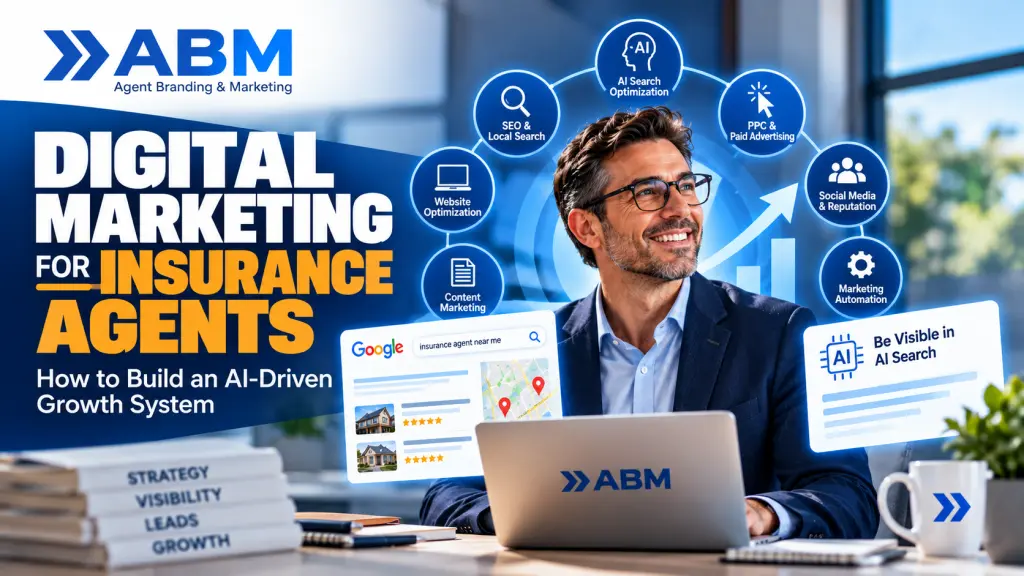
Digital Marketing for Insurance Agents: How to Build an AI-Driven Growth System
Stop managing disconnected marketing tactics. Build a coordinated ecosystem that connects search visibility, AI discovery, acquisition, conversion, and measurable agency growth.
Why Insurance Agency Growth Requires a Different Approach
Many insurance agencies are active across multiple marketing channels but still struggle to produce predictable growth. They may have a website, run advertisements, publish social posts, and buy leads—without a shared strategy connecting those investments to qualified opportunities and policies.
The problem is not always insufficient activity. It is often the absence of a coordinated growth system. Search visibility, advertising, reputation, website conversion, and follow-up must reinforce one another. When they do not, agencies spend more time managing channels than building market authority.
Digital marketing for insurance agents should begin with business objectives and market realities, use AI to multiply informed execution, and connect every channel to measurable outcomes.
What Is Digital Marketing for Insurance Agents?
Digital marketing for insurance agents is the coordinated use of online search visibility, targeted advertising, educational content, reputation management, website conversion, and follow-up systems to attract, convert, and retain insurance customers.
Marketing activity versus a growth system
Publishing a post is an activity; building a consistent body of useful insurance content is a system. Buying clicks is an activity; connecting search intent, landing pages, lead qualification, and follow-up is a system. An integrated approach makes each channel more valuable because the channels share strategic direction and performance data.
Why insurance is different
Insurance decisions depend on trust, timing, geography, carrier availability, and coverage needs. Independent agencies may differentiate through carrier options and advisory expertise; captive agents operate within carrier-specific branding and marketing rules. Both require messaging that reflects their actual capabilities and compliance obligations.
Why Traditional Digital Marketing Falls Short
Disconnected channels create disconnected results
SEO may bring visitors to one page while paid ads send prospects to another, with no consistent message or follow-up process. Without coordination, agencies cannot easily determine which activities are contributing to meaningful growth.
Lead volume is not the same as lead quality
A low cost per lead is not a win when inquiries fall outside the agency’s service area, do not fit available products, or never progress to a quote. Marketing must be evaluated against qualification and sales outcomes, not just form submissions.
Attribution and ownership matter
An agency needs clear definitions for a qualified inquiry, a booked conversation, a quote, and a bound policy. Shared measurement creates accountability and reveals where the customer journey needs improvement.
Start With Strategy Before Selecting Channels
The first question should not be “Should we run Google Ads?” It should be “Which customers and markets can this agency serve profitably, and what needs to change to win more of them?”
Define the growth objective
- Identify priority lines of business and geographic markets.
- Clarify whether the goal is new households, commercial accounts, cross-selling, or improved retention.
- Determine how many additional qualified opportunities the team can realistically handle.
Understand your market and ideal customers
Review competitor positioning, local search results, customer questions, current referral patterns, and the agency’s unique advantages. Segment prospects by relevant needs rather than assuming every insurance shopper follows the same path.
Build an accountable plan
Establish a baseline for qualified inquiries, acquisition cost, quote rates, binding rates, and retention where data is available. This is the foundation of an insurance agency marketing strategy that connects investment to business performance.
SEO and Local Search: Build Durable Visibility
Search optimization helps agencies appear when prospects actively research insurance coverage and local agents. It should include technically sound pages, clear service information, useful answers, internal links, and trustworthy business details.
Organic search
A strong SEO strategy for insurance agents aligns coverage-specific content with the questions people actually ask. Clear navigation and fast, accessible pages help both visitors and search systems understand the agency’s offerings.
Local search and Google Business Profile
Local visibility depends on relevant business information, geographic signals, appropriate profile categories, consistent contact details, and authentic reviews. Local SEO for insurance agents complements broader organic SEO rather than replacing it.
Neither organic nor local rankings can be guaranteed. The objective is to strengthen relevance, trust, and the likelihood that the right prospects discover and choose the agency.
AI Search Changes How Insurance Prospects Discover Agencies
Search experiences increasingly include AI-generated summaries and conversational answers. That changes how insurance questions may be explored before a prospect visits a website. Agencies should prepare by making their expertise and business information clear, consistent, and easy to verify.
Build a machine-understandable, human-useful presence
- Publish accurate explanations of the coverage and services actually offered.
- Maintain consistent agency identity, locations, and contact information.
- Organize content around meaningful questions rather than keyword repetition.
- Use appropriate structured data when it accurately represents visible content.
- Review AI-assisted content for factual accuracy and insurance compliance.
AI can help with research, workflow coordination, and content analysis, but it cannot guarantee inclusion in AI-generated answers. ABM’s AI Search Dominance approach treats AI discovery as part of the full growth ecosystem.
PPC and Paid Advertising: Reach Qualified Demand
Paid search can reach prospects who are actively looking for insurance options, while paid social may help build awareness or reconnect with relevant audiences where permitted. The value of paid acquisition depends on targeting, message relevance, landing-page experience, and the agency’s ability to respond.
Connect campaigns to business outcomes
Measure qualified inquiries, quote opportunities, acquisition cost, and downstream conversion—not clicks alone. Review geographic targeting, search terms, campaign exclusions, and landing-page alignment regularly.
Make paid and organic search work together
Search term data can inform useful content; strong educational pages can improve the overall customer experience. PPC management should support the same market objectives as SEO and social media advertising, not operate as separate experiments.
Your Website Is the Conversion Center
An insurance agency website must do more than look credible. It needs to explain the agency’s value, guide visitors to relevant coverage information, and make the next step easy.
- Clearly identify the agency, its service area, and available insurance offerings.
- Use prominent, specific calls to action for contacting the team or requesting a conversation.
- Keep forms concise and accessible on mobile devices.
- Show relevant credibility signals without unsupported promises.
- Monitor page performance and the quality of inquiries coming through each landing page.
A coordinated website design and development strategy connects search intent and advertising messages to practical conversion paths. Traffic without an effective next step is an incomplete investment.
Content, Social Media, and Reputation Build Trust
Publish useful insurance education
Answer real questions about coverage choices, policy reviews, claims processes, and situations where prospects may need professional guidance. Content should reflect the agency’s licensed offerings and avoid broad claims that do not apply to every policy.
Use social media to reinforce expertise
Social channels can extend the reach of useful articles, local community involvement, and educational resources. They should support recognizable agency positioning, not chase engagement without a business purpose.
Treat reputation as part of discovery
Accurate listings, authentic customer feedback, and professional responses help prospects assess an agency. Reviews should never be fabricated or incentivized in ways that violate platform rules or applicable regulations.
One substantive article can support a series of social posts, an email explanation, and an FAQ update, provided each version is reviewed for accuracy and usefulness.
AI and Marketing Automation: Scale Without Losing Control
Marketing automation helps agencies respond consistently when inquiries arrive, route opportunities to the right team member, and reduce repetitive administrative work. AI can assist with organizing insights, drafting internal materials, and identifying performance patterns.
Where automation can help
- Route new inquiries by location, line of business, or assigned producer.
- Send approved appointment confirmations and reminders.
- Support timely follow-up and CRM task creation.
- Flag incomplete records and gaps in the prospect journey.
- Summarize marketing performance for human review.
Keep oversight where it matters
Automation should respect consent requirements, carrier rules, privacy expectations, and the need for licensed professional judgment. Sensitive insurance recommendations and customer communications require appropriate human review.
Explore how marketing automation for insurance agencies fits within an accountable growth system.
Independent and Captive Agents Need Different Playbooks
The same marketing framework can support both business models, but execution must reflect each agency’s permitted products, brand rules, and competitive position.
Independent agencies
Independent agencies may emphasize advisory expertise, available carrier relationships, account development, and the ability to address multiple coverage needs, while accurately representing the products they can offer.
Captive agencies
Captive agents can build local relationships and communicate approved product value while following carrier branding, advertising, and content requirements. Market positioning should not imply flexibility or product availability that the carrier does not permit.
For both models, the right strategy is based on real customer needs, geographic opportunities, operational capacity, and compliant messaging.
Measure Marketing ROI Beyond Clicks and Impressions
Marketing reports should connect early indicators of visibility to meaningful business outcomes. A rising click count may signal attention, but it does not prove that an agency is acquiring profitable customers.
Metrics worth connecting
- Visibility: relevant search impressions, local discovery, and qualified website visits.
- Engagement: useful page interactions, contact attempts, and appointment requests.
- Acquisition: cost per inquiry, qualified inquiry rate, and cost per qualified opportunity.
- Sales: quote-to-bind rate, bound policies, and acquisition cost where data is available.
- Relationship value: retention, cross-selling, and account value over time.
Review these measures together. For example, a campaign with fewer inquiries may outperform a high-volume campaign if its leads are better qualified and more likely to become customers. Attribution will not always be perfect, so decisions should use multiple signals rather than one dashboard number.
A Six-Phase Roadmap for an AI-Driven Growth System
Phase 1: Audit the current position
Assess website performance, search visibility, business profiles, advertising, reputation, follow-up, and existing reporting. Identify the biggest gaps between activity and outcomes.
Phase 2: Set market and growth priorities
Define target customers, service areas, product priorities, competitive differentiation, and realistic capacity.
Phase 3: Strengthen core digital assets
Improve the website, key service pages, local profiles, measurement setup, and conversion paths before scaling acquisition.
Phase 4: Coordinate acquisition channels
Align organic search, paid media, educational content, and reputation initiatives around the same audience and message.
Phase 5: Integrate AI and automation
Use technology to improve analysis, workflow efficiency, and response consistency while preserving human oversight.
Phase 6: Optimize and expand
Review lead quality, sales outcomes, and market signals. Reallocate resources based on evidence and strengthen what is working. These phases are a logical framework, not a guaranteed timeline.
Why a Strategic Growth Partnership Changes the Equation
ABM is built around a different operating model: strategy first, AI as a multiplier, and an integrated ecosystem focused on the agency’s long-term position in its market.
Rather than treating SEO, PPC, content, local visibility, and automation as unrelated purchases, ABM connects them to shared priorities and ongoing measurement. That means evaluating not only whether a campaign ran, but whether the overall system is attracting appropriate prospects, converting opportunities, and supporting sustainable agency growth.
The objective is not simply to show up in search. It is to become a credible, relevant choice when local prospects are ready to act. Learn more about ABM’s integrated insurance marketing approach.
Frequently Asked Questions About Digital Marketing for Insurance Agents
What is the best digital marketing strategy for insurance agents?
The best approach depends on the agency’s market, products, budget, and capacity. A strong starting point is a coordinated strategy connecting local and organic search, a conversion-ready website, relevant acquisition campaigns, and consistent follow-up.
How much should an insurance agency spend on digital marketing?
There is no universal budget. Spending should reflect growth objectives, customer economics, competition, existing marketing performance, and the agency’s ability to handle additional opportunities.
Is SEO or PPC better for insurance agents?
They serve different purposes. SEO builds discoverability and authority over time, while PPC can reach relevant demand more immediately. The right mix depends on competition, budget, and acquisition goals.
How can independent insurance agents compete with larger agencies online?
Independent agents can focus on clear local positioning, relevant coverage education, authentic reputation signals, strong follow-up, and useful information tailored to their communities.
How does AI affect digital marketing for insurance agencies?
AI influences search discovery and can help teams analyze information and streamline workflows. Agencies still need accurate content, consistent business information, sound strategy, and human oversight.
Which digital marketing channels generate qualified insurance leads?
Search, local visibility, referrals supported by online reputation, and targeted paid campaigns can all contribute. Lead quality depends on audience fit, message relevance, landing pages, and follow-up.
How long does digital marketing take to produce results?
Paid campaigns may generate inquiries sooner than organic strategies, but results vary widely. SEO, reputation, and content typically require sustained effort. No specific timeline or outcome can be guaranteed.
What is the difference between local SEO and digital marketing?
Local SEO focuses on geographic search visibility, including local results and business profiles. Digital marketing is broader and also includes paid media, content, website conversion, reputation, and automation.
Can captive insurance agents use digital marketing?
Yes, subject to carrier requirements and applicable laws. Campaigns, brand materials, product descriptions, and lead-handling processes should comply with the agent’s specific restrictions.
How should an insurance agency measure digital marketing success?
Track qualified inquiries, appointments, quotes, bound policies, acquisition cost, and retention where available. Use visibility and traffic metrics as supporting indicators rather than final outcomes.
Build a Growth System Designed for Your Agency
Your agency does not need another disconnected marketing initiative. It needs a clear strategy, coordinated execution, and the ability to learn from real business outcomes.
Agent Branding & Marketing partners with insurance agents to connect AI-centric insight, search visibility, acquisition, conversion, and automation into a growth ecosystem designed around their markets and goals.