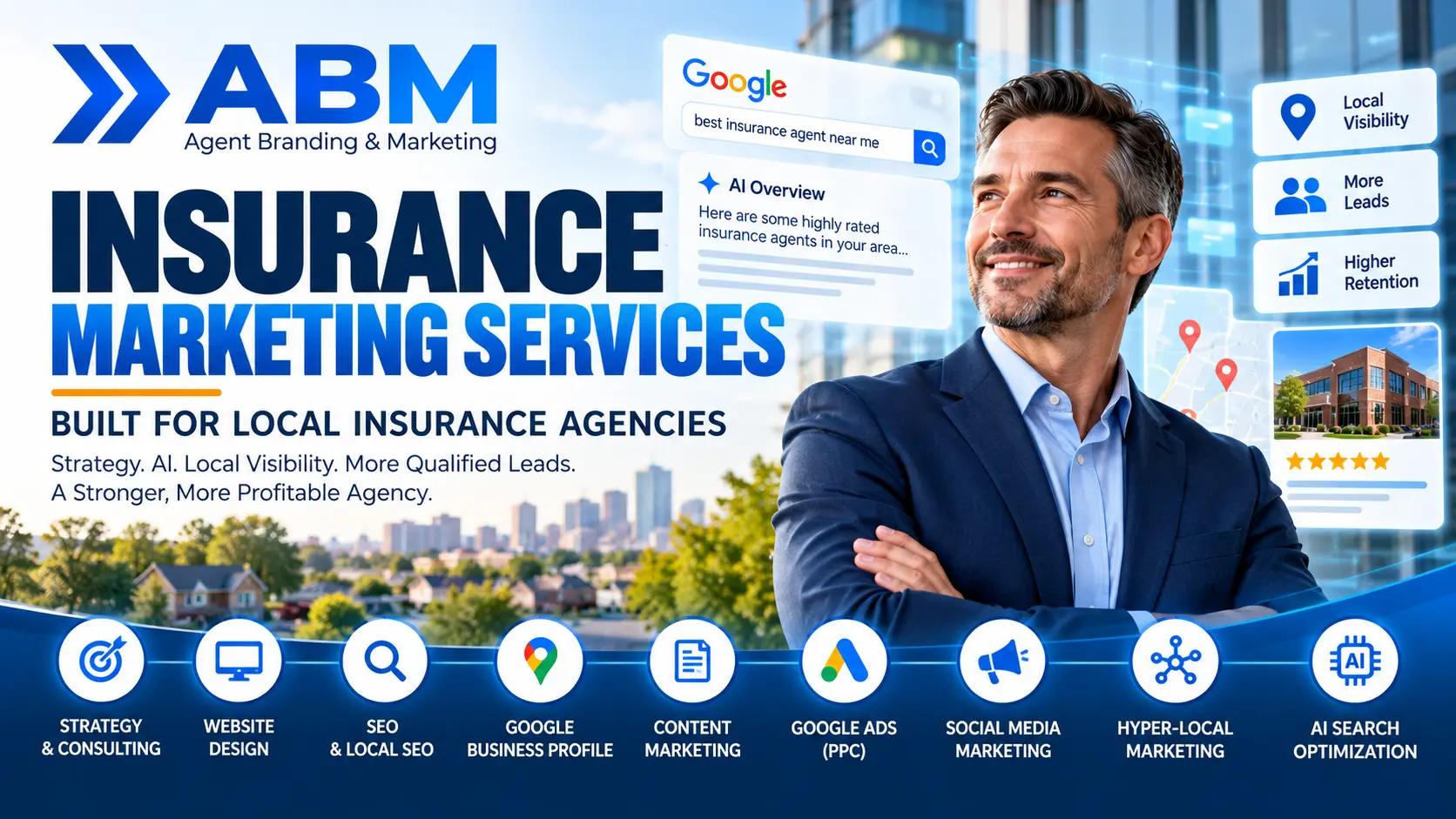
Strategy-Driven. AI-Centric. Insurance-Specific.
Insurance Marketing Services Built for Local Insurance Agencies
Insurance agencies do not have a shortage of marketing options. They have a shortage of coordination. SEO may be handled by one company, paid ads by another, social media by someone else, and the website may not support any of them. The result is a collection of activities instead of a growth system.
Agent Branding & Marketing (ABM) takes a different approach. We operate as a growth partner for insurance agencies, connecting strategy, AI, search, local visibility, paid media, content, social, web, reputation, and conversion into one integrated ecosystem designed to strengthen your market position over time.
Insurance Marketing Has Changed
Insurance shoppers no longer move through a simple path from advertisement to phone call. They search, compare, read reviews, view Google Business Profiles, scan websites, encounter social content, ask increasingly complex questions in AI-powered search experiences, and return later when they are ready to act.
That means your agency is being evaluated across multiple digital touchpoints before a prospect ever speaks with your team. Every touchpoint either strengthens trust or creates friction.
Your Prospects Do Not Follow a Straight Line
A typical insurance buyer may move through a journey like this:
- Searches Google for a local agent or a specific coverage question.
- Sees an AI-generated answer, Map result, organic listing, or paid result.
- Checks your Google Business Profile and recent reviews.
- Visits your website to evaluate credibility and expertise.
- Encounters educational content, video, social proof, or retargeting later.
- Returns when the need becomes urgent enough to request a quote or consultation.
Why Siloed Marketing Breaks Down
The individual tactic may not be the problem. The problem is what happens when the tactics do not reinforce one another.
- SEO can create visibility, but a weak website can waste the opportunity.
- Google Ads can create immediate traffic, but poor trust signals can suppress conversion.
- Social media can build familiarity, but disconnected messaging weakens the brand.
- A strong website can convert, but only if qualified prospects reach it.
- Great reviews can build confidence, but they work harder when search, content, and local visibility support them.
The ABM Growth Ecosystem
One Strategy. Multiple Channels. One Growth System.
ABM does not begin with a tactic. We begin with the agency, the market, the growth objective, and the competitive reality. Then we build the right mix of connected marketing systems around that strategy.
Strategy Determines the System
A sound insurance marketing strategy accounts for your lines of business, geography, competitive landscape, acquisition economics, current digital footprint, brand strengths, conversion gaps, and long-term growth objectives.
That is why our marketing strategy approach sits at the center of everything else we do.
AI Is a Multiplier, Not a Feature
ABM uses AI as infrastructure across research, content development, search optimization, analysis, campaign refinement, workflow, and the evolving AI-search environment. The objective is not to bolt AI onto traditional marketing. The objective is to make the entire growth system more responsive, informed, and scalable.
Insurance Marketing Services That Work Together
Each capability has a defined role. The advantage comes from how those capabilities reinforce one another.
Search Engine Optimization for Insurance Agencies
SEO builds durable discoverability and authority around the questions, services, locations, and insurance topics that matter to your market. That includes technical SEO, on-page optimization, content architecture, structured data, service relevance, and ongoing refinement.
The goal is not simply to rank. It is to make your agency easier for search engines, AI systems, and prospects to understand and trust. Explore SEO for Agent Branding & Marketing.
Local SEO for Insurance Agents
Insurance is local. High-intent prospects routinely search for an agent, agency, or coverage option tied to a city, neighborhood, or service area. Local SEO helps your agency compete for those moments by strengthening geographic relevance, local authority, citations, location content, and the signals that support visibility in local results.
See how ABM approaches Local SEO for insurance agencies.
Google Business Profile & Map Visibility
Your Google Business Profile is one of the most important local trust surfaces available to an insurance agency. It gives prospects immediate access to reviews, hours, location details, photos, updates, contact information, and the local proof that helps them decide whether to take the next step.
ABM connects Google Business Profile optimization with Local SEO, reviews, content, and broader search authority so the profile supports the entire ecosystem rather than operating as an isolated listing.
AI Search Optimization for Insurance Agencies
Search is becoming more conversational, more synthesized, and more dependent on machine understanding. Prospects increasingly expect search platforms to interpret complex questions, compare options, and surface useful answers directly.
Being ranked is no longer the only objective. Being understood, trusted, cited, and recommended matters too.
ABM’s AI Search Dominance for Insurance Agents approach connects traditional SEO with answer-focused content, entity clarity, structured information, topical depth, local authority, and the signals modern AI search systems use to understand a business.
Google Ads & PPC for Insurance Agencies
Paid search can place your agency in front of active buyers at the moment they express intent. But performance depends on more than bidding. Campaign structure, keyword intent, landing-page alignment, conversion tracking, lead quality, geographic targeting, and ongoing optimization all matter.
ABM uses paid media to capture immediate demand while the broader ecosystem builds long-term authority. Learn more about PPC management for ABM.
Social Media Marketing & Advertising
Social media gives insurance agencies a way to build familiarity before a prospect has an immediate buying need. Educational content, local relevance, video, community participation, agent personality, retargeting, and paid campaigns can all reinforce trust and brand recognition.
The strategic role of social is not simply to collect likes. It is to increase familiarity, reinforce credibility, create demand, and support the rest of the acquisition system. Explore social media ads for ABM.
Insurance Agency Website Design & Conversion
Your website is where accumulated trust has to turn into action. It should load quickly, work cleanly on mobile, explain why your agency is different, showcase proof, make coverage information easy to navigate, and give visitors a clear next step.
Traffic without conversion infrastructure wastes acquisition investment. See ABM’s approach to web design and development for insurance agencies.
Hyper-Local Insurance Marketing
Local markets are not monolithic. Cities, suburbs, neighborhoods, community events, industries, referral networks, and risk profiles can all create distinct opportunities. Hyper-local strategy allows an agency to develop relevance at the level where people actually live, work, and search.
Explore ABM’s hyper-local marketing for insurance agents.
Content & Authority Building
Insurance prospects have questions about coverage, cost, risk, claims, exclusions, local conditions, policy decisions, and common mistakes. Useful content turns your agency’s expertise into a discoverable asset that can support search, AI answers, Google Business Profile activity, social media, email, video, paid campaigns, and sales conversations.
That is ecosystem leverage: one strategic idea can strengthen multiple channels instead of disappearing after a single campaign.
Why Insurance Marketing Requires Insurance Expertise
Insurance is not simply another local-service category. Agency growth is shaped by carrier relationships, product availability, compliance requirements, geographic underwriting conditions, rate environments, retention, cross-selling opportunities, local competition, and the economics of each line of business.
A marketing strategy that ignores those realities may look polished while failing to support the way an insurance agency actually grows.
Independent P&C Agencies
Independent agencies often need to build a strong local brand while managing multiple carrier relationships, product options, service areas, referral sources, and cross-sell opportunities. Their marketing system should help them establish authority that belongs to the agency itself rather than to any one carrier.
Captive Insurance Agents
Captive agents compete within a carrier brand environment while still needing to differentiate locally. The challenge is often less about explaining the parent brand and more about establishing why a local customer should choose one agent over another in the same market.
Life & Medicare Agencies
Life and Medicare decisions can be research-heavy and trust-sensitive. Educational authority, clarity, local credibility, reviews, and helpful content become especially important when prospects are evaluating complicated decisions with long-term implications.
Partnership Over Vendor Relationships
From Marketing Vendor to Growth Partner
Vendors execute tasks. Growth partners take responsibility for how the pieces work together.
ABM is built around shared outcomes, strategic direction, continuous analysis, and long-term market development. That means we do not treat SEO, PPC, web, social, content, and AI search as separate deliverables with separate goals.
- Strategy comes before execution.
- Channels are evaluated by how they support the larger system.
- Lead quality matters more than raw lead volume.
- The system adapts as Google, AI search, media platforms, and local markets change.
- Performance is considered in the context of agency growth, not vanity metrics.
What an Integrated Insurance Marketing Strategy Looks Like
The exact mix should reflect your agency, but the growth sequence typically moves through five connected stages.
Stage 1: Build the Foundation
Clarify strategy, positioning, website experience, tracking, technical SEO, conversion paths, and Google Business Profile fundamentals.
Stage 2: Establish Authority
Develop insurance-specific content, localized relevance, reviews, search authority, and AI-search readiness.
Stage 3: Capture Existing Demand
Compete across Google Search, Maps, high-intent organic pages, paid search, and conversion-focused landing experiences.
Stage 4: Expand Demand
Use social media, video, educational content, retargeting, and community relevance to build familiarity outside the immediate search moment.
Stage 5: Optimize the System
Use search performance, conversion data, lead quality, cost metrics, written business, retention signals, and competitive movement to improve the strategy continuously.
Marketing becomes a feedback loop, not a collection of campaigns.
What Should Insurance Agencies Actually Measure?
No single metric tells the full story. The important question is whether the ecosystem is producing stronger visibility, better opportunities, more efficient acquisition, and sustainable growth.
Visibility Metrics
- Organic search visibility
- Local and Map visibility
- Search impressions and qualified traffic
- AI-search and answer-engine presence where measurable
Acquisition Metrics
- Qualified leads
- Conversion rate
- Cost per lead
- Cost per acquisition and lead source quality
Business Metrics
- Written business
- Revenue contribution
- Retention
- Customer acquisition cost and lifetime value where measurable
The goal is sustainable growth. Traffic without leads does not solve the problem. Leads without quality do not solve it. Low-cost acquisition without retention does not solve it. The system has to connect marketing performance to agency economics.
Who ABM Is Built For
ABM is built for insurance professionals who want more than isolated marketing activity. The fit is strongest for agencies that want a coordinated strategy for becoming more visible, more trusted, and more competitive in the markets they serve.
- Independent P&C agencies seeking stronger local authority, better-quality inbound opportunities, and less dependence on purchased leads.
- Captive insurance agents who need to differentiate locally while operating within carrier brand and marketing constraints.
- Life and Medicare agencies that depend on education, authority, trust, and search visibility to support complex buying decisions.
Frequently Asked Questions
Insurance Marketing Services FAQ
What are insurance marketing services?
Insurance marketing services are strategies and systems designed to help insurance agencies build visibility, trust, demand, and qualified customer acquisition. They can include SEO, Local SEO, Google Business Profile optimization, content, paid media, social media, website conversion, reputation, AI-search optimization, and strategic consulting.
What does an insurance marketing agency do?
An insurance marketing agency helps an agency reach, educate, and convert prospective policyholders. ABM goes further by connecting the individual channels into an integrated growth ecosystem so search, paid media, local presence, content, website experience, and AI-search visibility support the same strategic objectives.
How is insurance marketing different from general digital marketing?
Insurance marketing has to account for local competition, product availability, carrier relationships, compliance considerations, rate environments, lead economics, retention, cross-selling, and the trust required for financial-protection decisions. Those factors change how campaigns, content, search strategy, and conversion systems should be built.
How much should an insurance agency spend on marketing?
There is no universal marketing budget that fits every agency. The right investment depends on the agency’s revenue, market, competitive intensity, growth goals, lines of business, acquisition economics, existing assets, and how quickly the agency wants to build market share. ABM starts with strategy rather than forcing every agency into the same spending model.
What marketing works best for insurance agents?
The strongest approach is usually not one channel. It is a coordinated system that captures existing demand through search and paid media, builds authority through content and reviews, improves local visibility through SEO and Google Business Profile work, strengthens conversion through the website, and builds familiarity through social and video.
Should insurance agents invest in SEO or Google Ads?
SEO and Google Ads solve different parts of the acquisition problem. SEO can build durable organic and local authority over time, while paid search can capture immediate intent. In many markets, the strongest strategy uses both and allows the data from each channel to inform the other.
How long does insurance SEO take to work?
SEO is a compounding strategy rather than an instant campaign. Timing varies based on the condition of the site, competition, geography, existing authority, technical issues, content depth, and consistency of execution. Meaningful improvement is typically measured over months, with continued refinement required as search behavior and competitors change.
Why is Local SEO important for insurance agencies?
Insurance buyers often search with local intent and prefer agents who appear established in the community. Local SEO helps strengthen the signals that connect your agency to the cities, neighborhoods, services, and searches relevant to your market.
How is AI changing insurance marketing?
AI is changing both how marketing is produced and how prospects search. Search platforms increasingly summarize information, answer complex questions, and use machine understanding to identify useful sources. Insurance agencies therefore need clear entities, authoritative content, structured information, local trust signals, and a strategy built for both traditional search and AI-generated discovery.
How can insurance agencies appear in AI search results?
There is no single switch that guarantees AI-search visibility. Agencies can improve their foundation by publishing accurate, helpful, well-structured content; strengthening topical and local authority; maintaining consistent business information; earning credible reviews and mentions; using structured data appropriately; and making their services, locations, and expertise easy for machines to interpret.
Does social media work for insurance agents?
Social media can work well when it has a defined role in the larger system. For insurance agencies, that role may include local familiarity, education, community visibility, agent personality, video, retargeting, and trust-building rather than simply accumulating followers.
What should I look for in an insurance marketing company?
Look for insurance-specific understanding, strategic depth, clear measurement, cross-channel coordination, adaptability, transparent communication, and a focus on lead quality and agency economics rather than impressions alone. The company should be able to explain how each tactic supports a larger growth strategy.
Should an insurance agency use one marketing company or multiple specialists?
Multiple specialists can work, but someone must own the strategy and ensure the channels reinforce one another. When SEO, ads, content, web, and social are managed independently without shared data or common objectives, the agency can end up paying for fragmented activity. An integrated growth partner reduces that fragmentation by coordinating the system around shared outcomes.
Build the System
Build an Insurance Marketing System Designed for Market Dominance
The objective is not another campaign, another website, or another stream of generic content. The objective is an interconnected growth system that makes your agency visible when prospects search, credible when they research, authoritative when AI evaluates sources, familiar when they encounter your brand elsewhere, and easy to choose when they are ready to act.
Strategy provides the direction. AI provides leverage. The ecosystem provides compounding growth. ABM provides the partnership required to make the system work together.
Schedule an Insurance Marketing Strategy Session