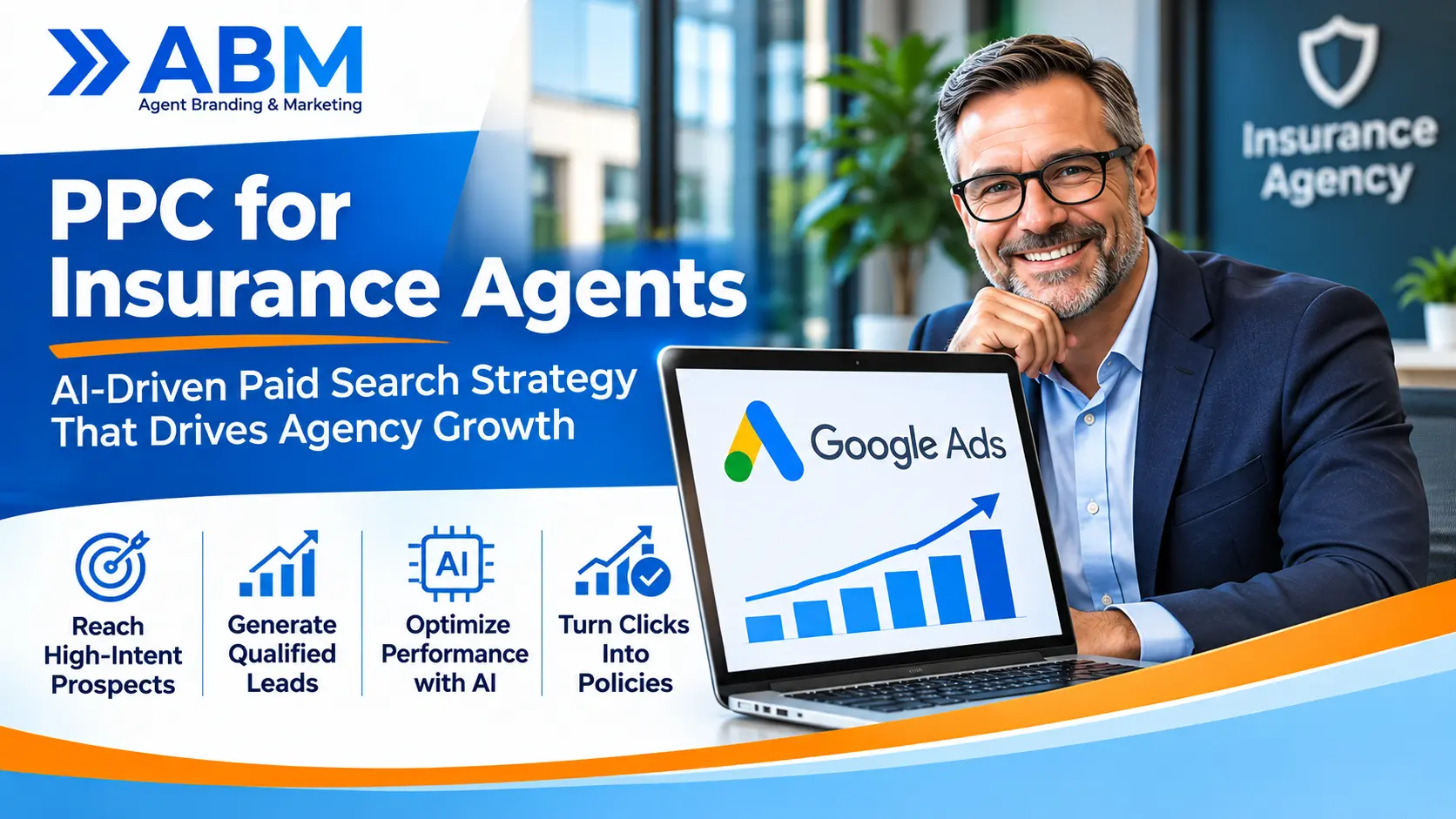
PPC for Insurance Agents: AI-Driven Paid Search Strategy
Turn high-intent insurance searches into qualified opportunities with a coordinated paid search strategy built around your market, product mix, and agency growth objectives.
Agent Branding & Marketing (ABM) connects PPC, conversion-focused websites, AI-assisted optimization, and lead follow-up into one accountable growth ecosystem. The goal is not more clicks. It is better decisions, stronger local positioning, and a sustainable path to acquiring the right customers.
Schedule a Growth Strategy Consultation Explore the ABM Growth Ecosystem
Why PPC for Insurance Agents Is a Strategic Growth Channel
Reach People Who Are Already Looking for Coverage
Paid search can put your agency in front of people actively researching coverage, comparing options, or looking for a local agent. The opportunity is not simply to buy visibility: it is to match a specific insurance need with a relevant message and a useful next step.
Support the Markets and Policies That Matter
A campaign should reflect your service territory, licensing, carrier appointments, preferred policy lines, and ability to respond to inquiries. An independent agency focused on commercial insurance needs a different plan from a captive agency seeking more local auto and homeowners opportunities.
Complement Long-Term Organic Visibility
PPC can provide targeted visibility while SEO for insurance agents builds organic authority. The channels should share search-intent intelligence without assuming paid placement improves organic rankings.
Why Insurance Agents Waste Money on PPC
Broad Targeting Creates Expensive Distractions
Campaigns can spend on irrelevant locations, low-intent searches, or products an agency cannot write. Geographic exclusions, keyword themes, negative keywords, and search-term reviews are essential.
Clicks Are Not the Same as Qualified Opportunities
A form submission is not automatically a viable prospect. Agencies need to distinguish inquiries from qualified leads, quotes, bound policies, and retained customers.
Weak Landing Pages and Slow Follow-Up Lose Momentum
Generic pages, confusing forms, weak mobile experiences, and delayed responses undermine campaign performance. PPC must connect to conversion-focused website experiences and dependable follow-up.
Disconnected Campaigns Hide the Real Economics
Ad platform dashboards rarely tell the whole story. Without CRM outcomes and a shared reporting framework, agencies can optimize for inexpensive leads that never turn into valuable business.
How PPC Advertising Works for Insurance Agencies
1. Identify Search Intent
Separate urgent quote and local-agent searches from educational questions. Organize campaigns around product lines and user intent rather than stuffing unrelated keywords into one ad group.
2. Build Relevant Targeting and Messaging
Align geography, insurance offering, ad copy, and landing-page language. Respect carrier, licensing, and platform restrictions.
3. Connect the Click to a Clear Conversion Path
Send prospects to a relevant page with clear coverage context, accessible contact options, and a simple next action.
4. Track What Happens After the Inquiry
Measure calls, forms, appointments, quotes, and policy outcomes where data and privacy requirements allow. Use those signals to guide decisions.
Connected journey: Relevant Search → Helpful Ad → Focused Landing Page → Qualified Inquiry → Agency Follow-Up → Quote or Policy Opportunity.
Google Ads for Insurance Agents: Campaigns Built Around Buyer Intent
Search Campaigns for High-Intent Demand
Google Search ads can address terms related to auto, homeowners, commercial, and life insurance. The right structure depends on actual market demand and the agency's approved products.
Brand, Nonbrand, and Product-Specific Searches
Separate searches for your agency name from general coverage searches so performance can be evaluated accurately. Use product-specific campaigns when volume, budgets, and landing pages justify them.
Hyper-Local Relevance
Match service areas and location settings to where the agency is licensed and can effectively serve clients. Local language should be accurate, not artificially repeated.
Remarketing and Other Formats
Other advertising formats may support a larger strategy, but audience use and targeting must follow applicable platform policies, privacy requirements, and insurance regulations. Not every feature is available to every advertiser.
How AI Strengthens Insurance PPC Strategy
Find Patterns Faster
AI-assisted analysis can help teams review search themes, performance changes, and gaps in campaign structure. The findings still need verification against real business data.
Develop and Evaluate Message Variations
AI can accelerate draft ad copy and landing-page testing. Human review remains necessary for accuracy, brand alignment, compliance, and clear promises.
Improve Decision Quality, Not Just Automation
The value of AI is its ability to support better prioritization across search terms, budget allocation, conversion signals, and customer outcomes—not simply to automate bids.
Keep Strategic Ownership With People
ABM's approach combines insurance-market understanding, AI-assisted workflows, and accountable decision-making. Technology is a multiplier within the growth system, not a substitute for it.
Why Landing Pages and Follow-Up Determine PPC Results
Match the Ad to the Destination
An ad about business insurance should lead to a relevant commercial insurance experience, not an unrelated generic homepage.
Build Trust Before Asking for Information
Make agency identity, location, appropriate credentials, coverage focus, and next steps easy to understand. Display testimonials and reviews only when permitted and accurate.
Remove Mobile Friction
Prioritize fast-loading pages, readable copy, usable forms, click-to-call options, and clear calls to action.
Connect Leads to a Working Process
Route inquiries promptly and use insurance marketing automation to support timely, appropriate follow-up. Automation should strengthen—not replace—personal agency relationships.
Measure PPC Performance Beyond Cost Per Click
Qualified Lead Cost
Calculate cost per qualified lead by dividing attributable campaign spend by the number of inquiries that meet your agency's agreed qualification criteria.
Quote and Bind Rates
Track what proportion of qualified leads become quotes and policies, when the agency can reliably capture those outcomes.
Customer Acquisition Cost
Evaluate advertising spend alongside other relevant acquisition costs, rather than confusing low CPC with profitability.
Retention and Long-Term Value
A policy's economics depend on product mix, retention, servicing requirements, and customer value. Budget decisions should reflect those realities.
Transparent Reporting
A useful scorecard connects spend, qualified inquiries, appointments, quotes, bound policies, and acquisition economics. Avoid presenting unverified averages as universal industry benchmarks.
- Ad spend and qualified inquiries
- Cost per qualified lead
- Lead-to-quote and quote-to-bind rates, when available
- Customer acquisition cost and retention indicators
PPC for Independent and Captive Insurance Agents
Independent Agencies
Independent agents may differentiate through multiple carrier relationships, specialized products, and consultative service. Campaign promises must still reflect actual appointments and availability.
Captive Agencies
Captive agents need to align ads, landing pages, and offers with carrier advertising standards, local market opportunities, and approval processes.
Life, Medicare, and Specialized Lines
These categories can require additional advertising and compliance controls. Campaigns should be evaluated individually rather than copied from a P&C template.
How Much Should Insurance Agents Spend on PPC?
Start With Agency Economics
There is no responsible universal budget. The right level depends on geography, search competition, product economics, conversion rates, and the team's capacity to handle leads.
Define a Learning Plan
Choose a manageable market and campaign scope, establish measurement, and allow enough data to evaluate lead quality. Avoid dividing a limited budget among too many unrelated campaigns.
Scale What Produces Qualified Outcomes
Increase investment based on evidence of useful inquiries and sustainable acquisition costs, not on traffic growth alone.
PPC and SEO: One Coordinated Insurance Growth Strategy
Different Timelines, Shared Objectives
Paid search can support targeted demand while organic search optimization builds longer-term visibility. Both should reinforce the same positioning and service priorities.
Shared Search Intelligence
Relevant search queries, customer objections, and landing-page results can inform content planning, ad messaging, and website improvements.
Local Authority Matters
Strong local SEO and consistent business information can support trust when prospective customers research an agency across multiple touchpoints.
PPC Within ABM's Integrated Growth Ecosystem
Strategy Sets the Direction
An insurance agency marketing strategy identifies the markets, policy lines, economics, and capacity that advertising should support.
Paid Search Creates Targeted Opportunities
PPC reaches relevant searchers with messages tied to real coverage needs and agency capabilities.
Website, Social, and Search Build Confidence
Website conversion, paid social advertising, and organic authority should reinforce—not contradict—the agency's positioning.
Automation and Reporting Close the Loop
Follow-up workflows and downstream measurement help the team learn which campaigns contribute to qualified business.
Partnership Connects the System
ABM's broader insurance marketing ecosystem brings the pieces together around agency growth rather than isolated channel activity.
Explore related services: SEO for Insurance Agents · Web Design and Development · Social Media Ads · Marketing Automation.
ABM's Strategy-First Approach to Insurance PPC
Discovery and Market Assessment
Understand agency goals, target policies, licensing footprint, competition, and current lead-handling capabilities.
Campaign and Measurement Strategy
Define audience intent, keyword themes, campaign architecture, budgets, landing-page requirements, and success metrics.
Conversion Infrastructure
Align forms, call tracking where appropriate, CRM processes, and reporting before scaling spend.
Launch and Quality Assurance
Check messaging, destination pages, tracking, geography, and compliance requirements.
AI-Assisted Optimization
Review search terms, message performance, lead quality, and budget use; use AI-assisted analysis with human validation.
Growth Reviews and Adjustments
Evaluate business outcomes and refine priorities as market conditions and agency needs change.
Why Partner With ABM for Insurance PPC?
Insurance-Specific Perspective
The strategy starts with the realities of insurance distribution, agency economics, and local competition.
AI-Centric, Not AI-Dependent
AI supports analysis and execution while experienced judgment governs decisions.
A Connected Growth System
PPC is designed to work alongside search visibility, conversion experiences, social authority, and follow-up.
Long-Term Accountability
The goal is a durable growth partnership built on priorities, measurement, and continuous improvement—not a disconnected campaign handoff.
Frequently Asked Questions About PPC for Insurance Agents
What is PPC advertising for insurance agents?
PPC, or pay-per-click advertising, allows insurance agencies to pay for eligible ad interactions, commonly clicks from relevant searches. Effective programs connect targeting and ad messaging to landing pages, qualification, and follow-up.
Does Google Ads work for insurance agents?
Google Ads can help insurance agencies reach people actively searching for coverage or a local agent. Results depend on competition, targeting, messaging, conversion experience, compliance, and lead handling.
How much should an insurance agent spend on PPC?
There is no universal budget. Set spending according to market competition, product economics, acquisition goals, available capacity, and a realistic measurement plan.
How much does an insurance PPC lead cost?
Costs vary substantially by coverage type, location, competition, and what counts as a lead. Qualified lead cost is usually more useful than a generic cost-per-click or raw form-submission benchmark.
Is PPC better than SEO for insurance agents?
They serve different roles. PPC can support targeted visibility through advertising, while SEO builds organic visibility over time. An integrated strategy uses both where they support agency goals.
How long does it take to see PPC results?
Ads may begin receiving traffic after approval and launch, but reliable conclusions about qualified leads and acquisition economics require enough meaningful data and downstream follow-up.
What are the best PPC keywords for insurance agents?
The best terms match the agency's products, licensed geography, and prospective customers' intent. High-intent local and coverage-specific searches are useful starting points, but actual query data should guide decisions.
Can captive insurance agents run Google Ads?
Many captive agents can advertise, subject to carrier rules, applicable laws, and platform policies. Approval requirements and permitted messaging vary.
How can an insurance agency improve PPC lead quality?
Improve keyword intent, geographic targeting, negative keywords, ad-to-page alignment, qualification questions, lead routing, and feedback from quotes and policy outcomes.
How does AI improve insurance PPC?
AI-assisted tools can help analyze patterns, develop message variations, and identify optimization opportunities. Human oversight remains important for accuracy, compliance, and strategic decisions.
Should PPC traffic go to an agency homepage?
A dedicated, relevant landing page is often preferable when it better matches the search and ad promise. The right destination depends on the campaign and customer journey.
What should I look for in an insurance PPC growth partner?
Look for insurance-market understanding, a clear measurement framework, attention to lead quality and compliance, conversion expertise, and accountability for the broader acquisition system.
Build a PPC Strategy That Supports Long-Term Agency Growth
Your agency does not need more disconnected advertising activity. It needs a coordinated approach that connects paid search investment to qualified opportunities, effective follow-up, and measurable business outcomes. ABM partners with insurance agencies to build that system.
Schedule Your Growth Strategy Consultation